
COP29 has completed without the major agreements needed following the “Global Stocktake” at last year’s COP28 which emphasised the need to cut global emissions by 43% by 2030 and 60% by 2035, amongst other areas of action. However, in a last minute development, developed nations agreed to increase the annual climate financing to developing countries to US$300 billion annually until 2035. “This new finance goal is an insurance policy for humanity, amid worsening climate impacts hitting every country,” said Simon Stiell, Executive Secretary of UN Climate Change. “But like any insurance policy – it only works – if premiums are paid in full, and on time. Promises must be kept, to protect billions of lives … It will keep the clean energy boom growing, helping all countries to share in its huge benefits: more jobs, stronger growth, cheaper and cleaner energy for all.”1 It is uncertain whether these financing targets will actually materialise into investments.
Importantly, as half the world’s population living across 70 countries voted in national elections this year2, the results reflect a focus on addressing personal, immediate, domestic issues over climate change; no public voted to stop climate change. The most significant of these was the US election earlier this month which saw the country elect Former President Donald Trump as its 47th President, someone who has publicly denied climate change previously, and vowed to increase oil and gas investments.
As outlined in last month’s Sign of the Times, across a number of critical issues facing the world today – including trade, wars and geopolitical relations – Trump won on the promise of bringing about a sharp departure from his predecessor’s policies3. And one of the most globally significant of these for which almost all countries around the world have acknowledged concern in the face of a sharp increase in natural disasers, is the issue of climate change.
The urgency of the climate crisis, and the limited window to act, is getting more apparent with every passing year of higher average surface and ocean temperatures and increased extreme weather events including heatwaves, droughts, extreme rainfall, and wildfires. Trump will return to power at a time when stakeholder cooperation and action are urgently called for by leading international agencies to accelerate the energy transition to renewables and ward off the worst impacts of climate change.
Climate policies during the first Trump Administration, together with his statements on the campaign trail, provide a clear indication that he is likely to pursue an “America First” policy that will likely see the US withdraw again from its obligations under the Paris treaty, double down on fossil fuel investments (including in fracking) and pursue deregulation while rolling back inhibitors to the fossil fuel industry. Whether there is a full rollback of the Inflation Reduction Act, which earmarked nearly US$500 billion for clean energy investments, remains to be seen, but it appears unlikely to survive in its current form.
Either way, the road America takes, as the second highest emitter today, and highest in history, will matter. If this plays out as expected, global climate goals and policies will need to be recalibrated and potentially reset. While making sense of this seems complex, the scope of the challenge can be looked at as a shift in the climate baseline, which can be understood through the UN’s “Shared Socioeconomic Pathways” (SSP) framework4. The framework provides the answer to understanding what US climate and energy policy under the incoming administration means for the world, essentially describing the consequences of pursuing a high-risk, high-growth approach which prioritises fossil fuel investments and growth at all costs.
As world leaders gathered in Baku, Azerbaijan for the annual COP29 Summit last week, the shadow of potential US disengagement from the Paris Agreement loomed large. China seemed to look to step up to fill the leadership vacuum left by the US and assume leadership for the Global South5. The conference provided a glimpse of the next four years; bitter debates for meagre incremental progress, increased pressure on the private sector to provide climate finance (likely unmet), a continued EU progression (also periodically shaken by its far right), and China looking to fill the global leadership vacuum which will be left as the US disengages.
This month’s Sign of the Times looks at the implications of America’s potential role in global climate change over the next four years, including the potential shift in US energy and climate policy, the consequences for emissions and temperature increases, and the broad implications for other stakeholders including other governments, the private sector, and civil society.
Context: The World’s Energy Trajectory
A number of critical transtions are underway, they include the transition to digital and artificial intelligence (AI), continued urbanisation, population growth, the rise of Asia … and the transition from fossil fuels to renewable clean energy. The next five years are critical to this inevitable energy transition.
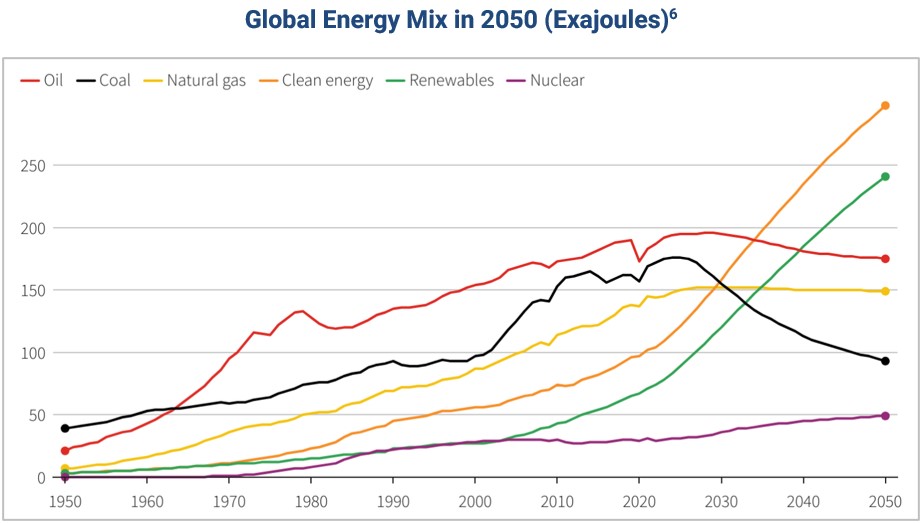
The logic of the transition is simple: fossil fuels got mankind this far but are not the answer to saving the planet’s ecosystems, controlling global temperatures and containing natural disasters, meeting the demands of the soon to be nearly 10 billion people on the planet, fuelling AI use, and propelling man into space, among many other demands for energy.
So, the context of this paper is the question, as the world transitions one of the most important elements underpinning any civilisation, its energy source, what does it mean for America and the world that its elected leader strongly denies the need for managing this change, eschewing the role of world leadership in driving this global transition, and chooses to place big bets on continuing to pump yesterday’s energy source.
America’s Likely Energy and Climate Policy in the Next Presidential Term
As the second largest emitter of greenhouse gases (GHGs) – the US accounts for c.12% of global emissions, second only to China which accounts for 34% of GHG emissions as of 20237 – the US plays a central role in any international effort to curb global warming. It is difficult for developed countries to argue that developing countries should pursue a more expensive carbon-neutral path if the largest polluter amongst them has per capita emissions that are five times higher than the low-income country average8, is pursuing fossil fuel investments unrestricted, and refusing to provide the necessary financing to developing countries for the path being suggested.
In this context, the outcome of the US presidential election holds immense significance for the direction of global climate policy. In 2016, Donald Trump’s victory marked a sharp departure from the Obama administration’s climate agenda. A strong proponent of deregulation, Trump rejected the idea and severity of the climate crisis and rejected mainstream climate science, and pursued a policy which withdrew America from multilateral cooperation on climate change, aggressively pursuing fossil-fuel investments and rolling back environmental regulations for industry and the energy sector.
In June 2017, six months after assuming power, Trump announced that the US would pull out of the Paris Climate Agreement, citing the economic burden it would place on the country, particularly the coal, If history holds, we would now see America withdraw from the Paris Agreement, pump more oil and gas than ever before and roll-back environmental protections, and negotiate trade deals not requiring its companies to comply with foreign climate regulations. oil, and gas industries, and disengaged with global climate negotiations. However, given the stipulated withdrawal window, the formal withdrawal only took effect on 4 November 2020 (one day after the election which saw him lose to Joe Biden). While Joe Biden re-joined the Paris Agreement on his first day in office to some relief, the damage to the US’ credibility as a reliable counterparty in global climate agreements had already been done.
Climate Agreement, citing the economic burden it would place on the country, particularly the coal, oil, and gas industries, and disengaged with global climate negotiations. However, given the stipulated withdrawal window, the formal withdrawal only took effect on 4 November 2020 (one day after the election which saw him lose to Joe Biden). While Joe Biden re-joined the Paris Agreement on his first day in office to some relief, the damage to the US’ credibility as a reliable counterparty in global climate agreements had already been done.
In addition, the first Trump Administration also rolled back a range of domestic environmental protections, including the Clean Power Plan, which aimed to reduce carbon emissions from the power sector, and regulations on methane emissions from oil and gas operations. Under his leadership, the US saw an increase in fossil fuel production, particularly in oil and natural gas, and the promotion of coal as a key energy source. These policies were framed as part of an “America First” agenda that prioritised economic growth, job creation, and energy independence, but contradicted the growing international consensus on the urgent need to transition to renewable energy sources to mitigate climate change.
Trump has echoed all these positions on the campaign trail, and also gone further to promise that he will look to undo any incremental progress made by the Biden administration, for example through the Inflation Reduction Act (“IRA”) which mobilised c.US$500 billion towards climate investments9. Trump will return to power in January with an even stronger mandate, having secured at least 77 million votes (vs. 63 million in 2016), and having won the popular vote with just shy of 50% of the votes cast10 (something a Republican presidential candidate has only done once since the end of the Cold War) the House, Senate and White House,.
This suggests a return to these policies in his second term, which if true to the past and recent pronouncements are likely to feature the following:
-
Withdrawal from Paris Agreement. A second withdrawal from the Paris Agreement would erode trust in the US as a reliable participant in global climate efforts (and have an effect on other arena too). This decision would send a harsh signal to the global community on the direction of collective global action, undermining multilateral climate frameworks and more. Other nations might follow suit, reducing the effectiveness of the agreement and encouraging a fragmented approach to climate policy. The lack of US leadership, particularly as one of the largest emitters, would embolden countries with less ambitious climate goals to delay their commitments. Additionally, it would complicate negotiations in future climate summits, where trust and cooperation are crucial. Developing countries, already skeptical due to unmet financial commitments from developed nations, would face even more challenges in advancing their climate agendas without the support of the world’s largest economy.
-
Aggressive Support of Fossil-Fuel Investments.A US emphasis on expanding fossil-fuel production and consumption directly contradicts international calls for decarbonization, and by prioritizing coal, oil, and natural gas, the US risks setting a counterproductive example for developing countries, many of which rely on fossil fuels for growth. Without leadership from developed nations, developing economies might well question why they should adopt costlier renewable technologies while the US pursues carbon-intensive policies. This could slow global Without leadership from developed nations, developing economies might well question why they should adopt costlier renewable technologies while the US pursues carbon-intensive policies. progress toward climate targets and exacerbate emissions growth. Furthermore, increased US production of fossil fuels would lower global prices, making it economically harder for renewable energy sources to compete. Developing economies might choose cheaper fossil fuel options, delaying the energy transition. Such policies also strain diplomatic efforts, making it harder to build consensus on climate financing mechanisms essential for a global shift to sustainable energy.
-
3. Environmental Deregulation. By dismantling environmental protections, the US under Trump’s second term could weaken global environmental governance. Reduced restrictions on methane emissions, pollution, and industrial waste create a ripple effect, encouraging other nations to adopt similar deregulatory stances in pursuit of economic gains. For industries, fewer environmental regulations lower compliance costs, potentially boosting short-term profits. However, this comes at the expense of public health, ecosystem integrity, and long-term sustainability. On the global stage, the rollback of these regulations sends a message that economic priorities outweigh environmental considerations, undermining decades of progress in environmental policy. Other nations might hesitate to strengthen their own environmental protections, fearing economic disadvantages. Ultimately, deregulation exacerbates environmental degradation, accelerates climate change, and challenges the global push for sustainability.
-
4. Rollback of IRA Incentives for Climate Innovators. Trump’s commitment to dismantling the Inflation Reduction Act (IRA) would significantly weaken US climate financing efforts. The IRA has mobilised nearly US$500 billion toward renewable energy, energy efficiency, and carbon capture initiatives, forming the backbone of the US energy transition strategy. It has also put America at, The IRA has mobilised nearly US$500 billion toward renewable energy, energy efficiency, and carbon capture initiatives, forming the backbone of the US energy transition strategy. It has also put America top of the agenda for any innovator in the field of climate technology.the top of the agenda for inward investment for any innovator in the field of climate technology. Rolling back these provisions would disrupt momentum for clean energy projects and reduce incentives for innovation in low-carbon technologies. This shift places an additional responsibility on America’s private sector to finance the energy transition. This will be challenging because it will mean going against the direction of travel favoured by a combatitive president, and trying to do so in the absence of additional government incentives and reducing public climate investments. Internationally, the rollback would signal reduced US leadership on climate finance, discouraging other nations from making similar investments and further complicating global efforts to secure funding for climate mitigation and adaptation.
Taken together, this has the potential for even more pronounced consequences for global climate governance and financing as these policies will in all likelihood increase the baseline emissions trajectory, make global climate negotiations far more challenging, and place an additional burden on the private sector to finance the energy transition, which they have not shown signs of doing thus far and will not be pressured to do from America at least.
While one can pursue a strategy in the climate arena of disruptive change that yields positives, the question is whether there is the likelihood that one will be found and pursued here? And if it is, whether the risks are well understood and likely to be managed?
The Potential Shift in the Climate Baseline
If the potential policy shifts were along the lines articulated in the election campaign by Trump and evident from the previous term, what effect might these have on the global baseline level of climate change? This can best be understood through the United Nations’ ‘Shared Socioeconomic Pathways (SSP)’ framework11. This framework identifies five potential global socioeconomic evolution scenarios over the remainder of the 21st century. Each scenario is based on a set of assumptions for critical quantitative factors such as population growth, economic growth, urbanisation, energy intensity and mix of energy sources, as well as qualitative factors such as the level of international cooperation, investement and inequality within and amongst nations. This in turn determines the scope of the climate policy challenges to both mitigate climate change, and to adapt to the consequences of climate change.
Importantly, the SSPs only provide the baseline emissions and temperature trajectory in the absence of any major climate policy and financing interventions. Each SSP effectively creates a different scenario under which climate policy will need to be formed and implements, and on which different interventions can be overlaid to arrive at the actual emissions and global temperature trajectory.
The underlying assumptions for the socioeconomic evolution of the world under the five SSPs, along with the potential climate outcomes in terms of emissions and temperature increases by 2100 (in the absence of any policy interventions) is summarised in the table below:
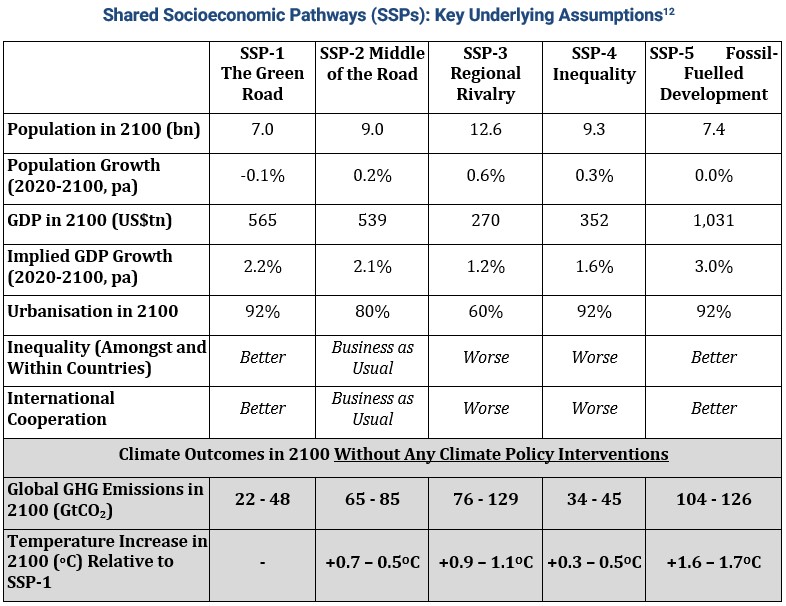
The resulting emissions and global temperature trajectories have important implications for all global stakeholders including policymakers, the private sector and civil society.
Firstly, they show the urgency of climate action. Even in the best case scenario, SSP-1 (The Green Road), where the world voluntarily shifts to a more sustainable energy trajectory, with lower inequality, strong multilateral coordination is required to enact meaningful climate policies. However, in this scenario, the conditions are there for climate policy action on both mitigation and adaptation given levels of economic growth combined with lower inequality and improved multilateral engagement, so the likelihood of incremental global climate policies keeping the global temperature increase within the targeted 1.5-2.0oC range is higher (as outlined in the next section).
Secondly, they show the risks of nationalism and division, when it happens on a global scale. On the other extreme of SSP-1 is SSP-3 (Regional Rivalry), which presents significant challenges to both climate change mitigation and adaptation, with a nationalist approach adopted by an increasing number of countries combined, increased inequality and multilateral disengagement undermining both the energy transition to renewables and inhibiting the rapid economic growth that is necessary to invest in innovation and adaptation. As countries compete, each power prioritises its own energy security (whether through fossil fuels or green energy), even at the expense of others, and international climate finance gaps persist as a result of declining multilateral cooperation, resulting in higher temperature increases (even though global economic growth and energy needs are lower). In this socioeconomic context, it becomes difficult to enact any meaningful multilateral climate policy agreements, making action or either climate mitigation or adaptation near impossible.
Thirdly, it suggest that a “My Country First” approach which prioritises only economic growth at the expense of climate is risky for the world. In SSP-5 (Fossil-Fuelled Development), without meaningful energy innovation and global climate policy breakthroughs, the prioritisation of economic Without meaningful energy innovation and global climate policy breakthroughs, the prioritisation of economic growth combined with the continued pursuit of fossil-fuel investments leads to an even higher global temperature increase. growth combined with the continued pursuit of fossil-fuel investments leads to an even higher global temperature increase compared to SSP-3. The risky bet in this scenario is that delivering economic growth translates into improved international cooperation and rapid economic convergence for developing countries, allowing all to invest in adapting to the changing climate, and also accelerating the transition of economies to less energy-intensive services based economies.
Fourth, it shows the criticality of multilateral coordination and reducing global inequality. In SSP-4 (Inequality), even when growth is lower, if inequalities between and within nations persist, the world ends up with the ‘worst of worlds’. Economic growth is significantly worse versus. the current path SSP-2 (Middle of the Road) and SSP-1, but emissions and global temperature increases are meaningfully higher. The only respite in this scenario is that lower growth, particularly in the developing world, puts these countries on a lower emissions trajectory vs. if they were to converge to developed country consumption levels.
Potential Climate Outcomes in Each SSP
Each scenario therefore provides a different baseline and context under which global climate policy will be formed and climate financing decisions taken, and as a result, there are differing probabilities about what the actual temperature increase (after overlaying potential policy interventions) may be. Climate models have estimated the impact of various policy and financing interventions, and can help assess the probability of achieving different climate outcomes, defined by ‘Representational Concentration Pathways’ (“RCPs”)13, for each of the scenarios. Various climate models differ about the potential policy evolution in each scenario, however, when analysed together, they point to a clear indication of the probability of the world actually warding off the worst impacts of climate change.
The table below summarises the percentage of publicly-available climate models which predict the successful achievement of various temperature targets ranging from the aspirational 1.5oC warming outcome to the dire scenario of more than 4OC of warming.
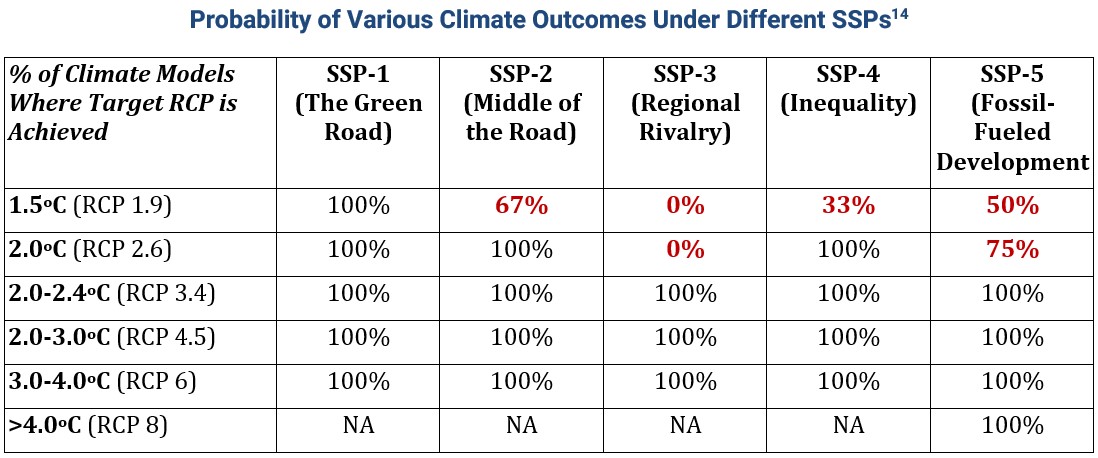
The analysis above clearly shows there is a significant risk in the world missing its climate objectives in both SSP-3 and SSP-5, which appears to be the new direction of the world following the US election.
Implications of Global Warming Hitting 3.0oC
What are the chances of containing temperatures to around 1.5OC, and avoiding the calamities of 2OC to 3oC? The answer is, dire, in the absence of global leadership, which would best come from America bringing all its political, technological and financial ingenuity to the bear on the problem.
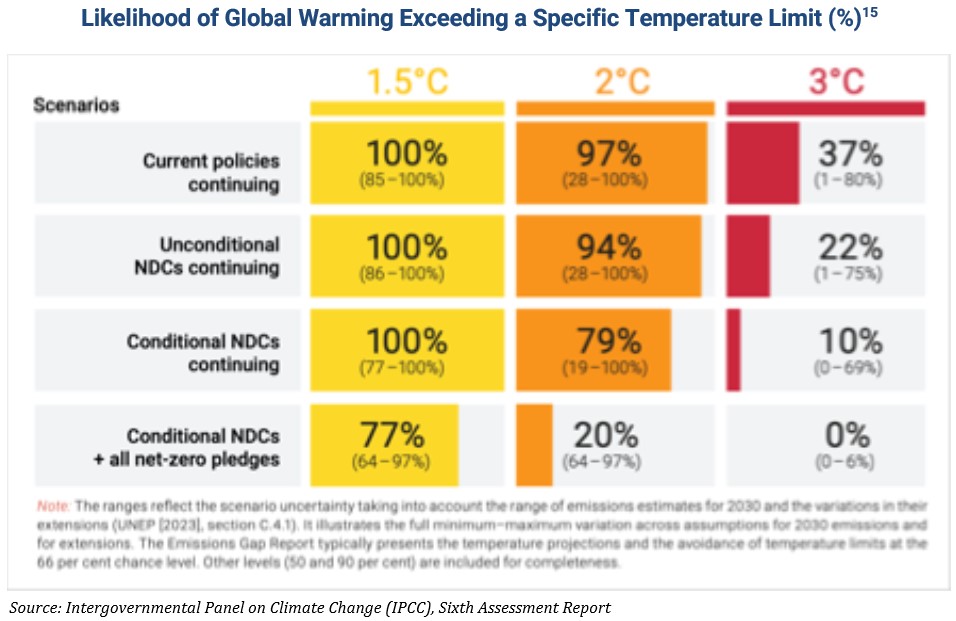
What difference does a couple of degrees make? In the oft-quoted parlance of global climate discussions and debates, it is often forgotten why the world needs to aim for a 1.5OC temperature increase (measured against pre-industrial levels), as the Paris Agreement seeks to do, a level that as of 2023, has officially been breached, with temperatures between February 2023 and January 2024 1.52OC higher vs. pre-industrial (1850-1900) average temperatures16. The impact of this is already visible in the form of unprecedented heat waves and extreme weather events across the planet over the last year17. In this context, it is important to note that limiting the global temperature increase to 1.5OC will not reduce these, it will simply keep the global climate at current levels for the forseeable future.
Unfortunately, based on the assessment of the current climate policies, the world is currently heading to 2.7OC of warming by 210018. What would a temperature increase of 3.0OC rather than 1.5OC actually mean?
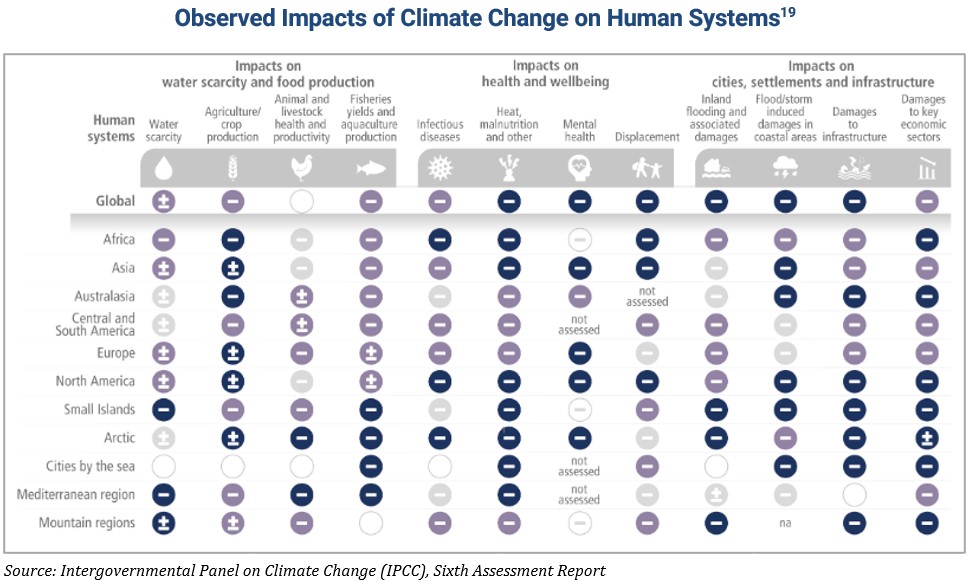
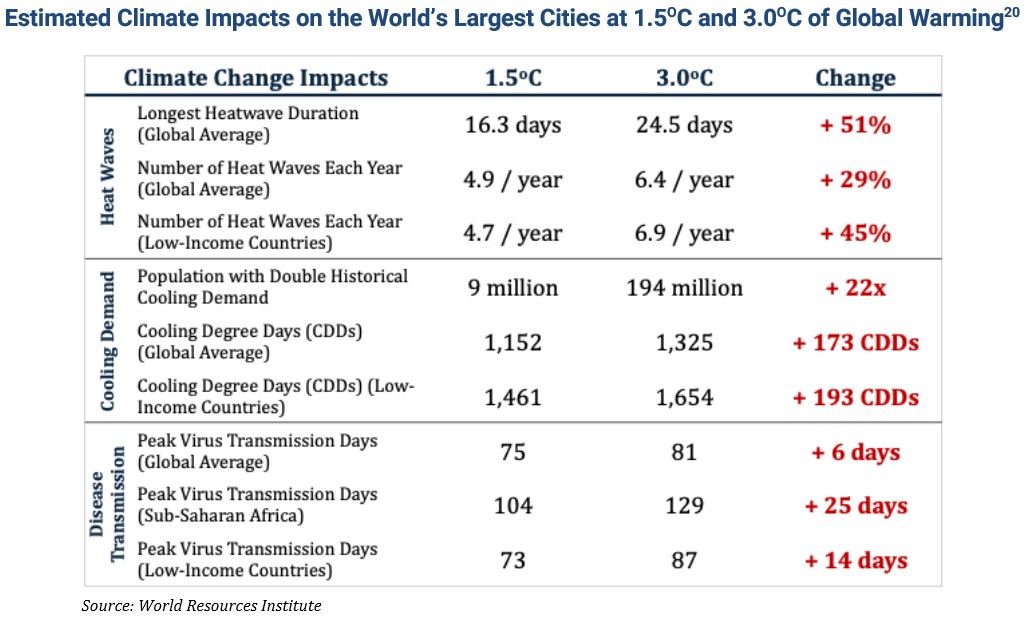
The data suggests such a temperature increase would profoundly impact the planet, particularly in the world’s largest cities, leading to longer, more frequent, and more intense heatwaves, creating uninhabitable outdoor conditions and driving a sharp increase in energy demand for cooling, potentially initiating a vicious cycle. This scenario would exacerbate extreme rain events, coastal flooding from rising sea levels, and the spread of transmissible diseases like malaria. Global agriculture could face catastrophic disruptions, with declining crop yields and livestock stress due to water scarcity, while industries and supply chains would struggle to adapt. Urban infrastructure would become increasingly vulnerable to flooding, heatwaves, and displacement pressures, while energy systems would face challenges from variable water availability. In the western United States, prolonged droughts, wildfires, and water shortages are expected to severely damage agriculture and urban areas, and coastal regions in North America and Europe would contend with inland flooding and costly adaptations for energy and infrastructure. The Global South would bear the worst impacts, experiencing heightened food insecurity, economic losses, and mass displacement due to limited resources for adaptation, amplifying existing vulnerabilities and inequalities and driving migration to the North, which today cannot absorb today’s comparably low levels of immigrant flows without voting in hate and extremism.
The table below summarises the estimated incremental impact of an additional 1.5OC of global warming above the Paris Agreement target, where the world is currently headed.
How a Second Trump Administration Could Negatively Shift the Baseline
The intentioned path of the incoming administration’s policy path seems to be a shift in American policy to SSP-5 (Fossil-Fuelled Development) with the aim of driving economic growth in the US, and driving innovation. In this scenario, US economic growth has the potential to drives global growth and income convergence, allowing developing countries to invest in their own energy security and adapting to the potential impacts of climate change. However, notably, wealth creation across the world has shown income divergence, and led to more power for conservative and far right groups21.
However, for this scenario to be realised, the burden on international cooperation and investment is high. It assumes multilateral coordination and climate financing (including large scale cross-border solution and financial flows). It also assumes that technological breakthroughs will somehow manage the increased energy consumption and climate impacts, with a baseline projected temperature increase of 4.7-5.1OC by 2100 without further major climate policy interventions or technology breakthroughs. From a climate policy perspective, this scenario would present significant challenges to mitigating climate change, however given the higher level of growth in developed countries, potentially relatively fewer challenges for climate change adaptation.
An “America First” approach is clearly at odds with multilateralism and its manifestation in other areas – for example trade policy, or policy relating to the Middle East conflict, or eschewing of multilateral engagement – could lead to a breakdown of multilateral cooperation which makes it difficult for developing countries to catch up and transition their economies and energy sources, escalating trade wars that drive inflation and lower global growth, and escalating violent conflicts with other powers stepping in as the US disengages. Collectively, this could push the baseline emissions closer towards SSP-3 (“Regional Rivalry”), where nationalism reigns and countries aggressively pursue independent fossil fuels development to ensure their energy security. In this scenario, the world gets higher emissions than the current baseline – average temperatures are projected to increase by 3.9-4.6OC by 2100, even though economic growth is significantly lower. This scenario presents a high degree of challenges for both climate change mitigation and adaptation.
In conclusion, without grand strategies that are multilateral in nature, or led by massive investments to deliver innovation, nationalist ‘country first’ approaches lead the world to regionalisation implied in SSP-3. Consequently, by the end of the second Trump Administration, the 1.5OC will be even further out of reach.
Conclusion: A Leadership Imperative for Other Stakeholders
America has been a unipolar power essentially since the fall of the Berlin Wall, and has set the rules of engagement for the rest of the world. This has led to an expectation that it is the natural leader on all major issues, climate change being no exception.
At this critical time where the UN and world scientists have raised the alarm on losing the opportunity to halt rising temperatures, America has the ability to determine the direction of climate change policy and progress around the world. The signalled direction of the second Trump Administration is to destabilise multilateral efforts to combat climate change, accelerate fossil-fuel investments and reliance, and delay the transition to renewable energy. In this new emerging reality, the absence of US leadership to address this issue will force other stakeholders – including governments, the private sector, and civil society – to adapt and collaborate to address the climate crisis. If they rise to the challenge well, a new mode of leadership will develop.
For governments, particularly major powers and those leading the charge on climate action, the challenge will be to balance their energy security and environmental sustainability priorities in a landscape increasingly shaped by fragmented multilateralism. With the baseline of climate change likely to shift either towards SSP-3 ("Regional Rivalry") or SSP-5 ("Fossil-Fuelled Development"), there is a risk of nationalist policies undermining global cooperation. China and the European Union in particular will need to recalibrate their roles, and step into the leadership vacuum left by the US to drive the global climate agenda. US disengagement will also catalyse ‘South-South’ cooperation to advance domestic climate goals and provide support to low-income countries in decarbonising their economies, providing an opportunity for large developing countries like China and India to lead. India as a rising economy expected to become a top three economy by 2050, is a critical player (already in the top-5 emission league) and can play a decisive role too. However, as with any leadership transition, such a global transition to emerging powers and power blocs is unlikely to be seamless, and in the short-term, most nations will likely struggle to prioritise long-term sustainability, particularly in the face of domestic fiscal pressures.
In such a scenario, the private sector will be called upon to bear a disproportionately larger burden in financing and driving the energy transition, particularly as public investments in renewable energy wane in the US. However, much of the world’s capital is managed by US financial institutions, and if these align with the new Administration, as witnessed through the recent presidential campaign, it is unlikely the world’s biggest investors will fund climate change. Where investments are made, investments are likely to skew toward lower risk, profitable ventures rather than equitable solutions, leaving vulnerable communities and developing regions further behind.
On the flip side, businesses and private investors have a unique opportunity to lead a major change by creating a global market for solutions. By prioritising sustainability in their operations, investing in low-carbon technologies, and adopting adaptive business models, corporations can influence both market trends and policy environments. The tech industry has become one of the biggers implementers and buyers of clean energy to fuel the rise of their AI and digital businesses. The private sector would also need to align with global climate targets, recognising that the long-term risks of inaction – extreme weather, resource scarcity, and economic instability – far outweigh the short-term benefits of maintaining the status quo. The EU and China are currently leading in regulation and preparation for this world, and if they invest well, have a unique opportunity to lead the world into a transition that America looks set to walk away from, at least in the near term.
Finally, citizens and civil society will play a pivotal role in navigating this shifting landscape. If America erodes trust in multilateral agreements and weakens global climate financing mechanisms, the onus will fall on citizens, and NGOs to step up to address the dual challenges of mitigation and adaptation. Citizens in 2024 did not vote in groups prioritising this change, many voted for the exact opposite, but as the pressure builds, this may change. Beyond lobbying for systemic change, civil society would need to embrace localised, adaptive solutions that empower communities to face the immediate impacts of climate change, such as rising sea levels, extreme heat, and resource shortages.
Ultimately, the path ahead demands unprecedented innovation, cooperation, and resilience. While the incoming Administration’s policies may shift the global baseline towards more challenging scenarios, if the worst outcomes are to be avoided, other stakeholders will need to steer outcomes towards minimising harm and ensuring adaptation. The climate crisis will not pause for political cycles; it remains an enduring test of humanity’s capacity to act decisively for a sustainable future. By embracing a shared vision that transcends nationalism and short-term gains, global stakeholders can keep alive the possibility of limiting the worst impacts of climate change.
Endnotes
- UN Climate Change (24 November 2024). COP29 UN Climate Conference Agrees to Triple Finance to Developing Countries, Protecting Lives and Livelihoods (Press Release). https://unfccc.int/news/cop29-un-climate-conference-agrees-to-triple-finance-to-developing-countries-protecting-lives-and
- O’Neill, A. (9 November 2024). Global elections in 2024 - Statistics & Facts. Statista. https://www.statista.com/topics/12221/global-elections-in-2024/#topFacts
- Sign of the Times (October 2024). The Leader: The US Election and Implications for the World. Greater Pacific Capital. https://www.greaterpacificcapital.com/thought-leadership/the-us-election-and-implications-for-the-world
- Patel, K., & Hansmeyer, C. (2024). COP28 and its impact on the shared socioeconomic pathways. Frontiers in Environmental Economics, 3, Article 1315159. https://doi.org/10.3389/frevc.2024.1315159
- Shepherd, C. & Northrop, K. (23 November 2024). China looks to step into global vacuum as Trump vows to pull U.S. back. Washington Post. https://www.washingtonpost.com/world/2024/11/23/china-climate-leadership-cop29/
- International Energy Agency (IEA) (October 2024). World Energy Outlook 2024. https://www.iea.org/reports/world-energy-outlook-2024
- Crippa, M., Guizzardi, D., Pagani, F., Banja, M., Muntean, M., Schaaf, E., Monforti-Ferrario, F., Becker, W.E., Quadrelli, R., Risquez Martin, A., Taghavi-Moharamli, P., Köykkä, J., Grassi, G., Rossi, S., Melo, J., Oom, D., Branco, A., San-Miguel, J., Manca, G., Pisoni, E., Vignati, E. and Pekar, F. (2024). GHG emissions of all world countries. Publications Office of the European Union. Luxembourg. https://publications.jrc.ec.europa.eu/repository/handle/JRC138862
- Fengler, W., Gill, I. & Kharas, H. (7 September 2023). Commentary: Making emissions count in country classifications. Brookings. https://publications.jrc.ec.europa.eu/repository/handle/JRC138862
- Congressional Budget Office (September 2022). Estimated Budgetary Effects of Public Law 117-169, to Provide for Reconciliation Pursuant to Title II of S. Con. Res. 14. https://www.cbo.gov/publication/58455
- 2024 Presidential Election Results (26 November 2024). Associated Press. https://apnews.com/projects/election-results-2024/?office=P
- Patel, K., & Hansmeyer, C. (2024). COP28 and its impact on the shared socioeconomic pathways. Frontiers in Environmental Economics, 3, Article 1315159 https://doi.org/10.3389/frevc.2024.1315159
- International Institute for Applied Systems Analysis (2018). SSP Database Shared Socioeconomic Pathways – Version 2.0. https://tntcat.iiasa.ac.at/SspDb/dsd?Action=htmlpage&page=welcome
- The RCPs do not provide any socioeconomic context, they simply show climate outcomes given differing amounts of GHGs emissions
- Rogelj, J., Popp, A., Calvin, K.V. et al (2018). Scenarios towards limiting global mean temperature increase below 1.5 °C. Nature Climate Change 8, 325–332. https://doi.org/10.1038/s41558-018-0091-3
- PCC (2023). Summary for Policymakers: Climate Change 2023: Synthesis Report. Contribution of Working Groups I, II and III to the Sixth Assessment Report of the Intergovernmental Panel on Climate Change [Core Writing Team, H. Lee and J. Romero (eds.)]., IPCC, Geneva, Switzerland, pp. 1-34, doi: 10.59327/IPCC/AR6-9789291691647.001
- Copernicus Climate Change Service, European Union (February 2024). January Climate Bulletin: Copernicus: In 2024, the world experienced the warmest January on record. https://climate.copernicus.eu/copernicus-2024-world-experienced-warmest-january-record
- McSweeney, R. & Tandon, A. (18 November 2024). Mapped: How climate change affects extreme weather around the world. Carbon Brief (Interactive). https://interactive.carbonbrief.org/attribution-studies/index.html
- Climate Action Tracker (November 2024). Warming Projections Global Update. https://climateactiontracker.org/documents/1277/CAT_2024-11-14_GlobalUpdate_COP29.pdf
- IPCC (2023). Summary for Policymakers: Climate Change 2023: Synthesis Report. Contribution of Working Groups I, II and III to the Sixth Assessment Report of the Intergovernmental Panel on Climate Change [Core Writing Team, H. Lee and J. Romero (eds.)]., IPCC, Geneva, Switzerland, pp. 1-34, doi: 10.59327/IPCC/AR6-9789291691647.001
- Wong, T., Campos, R., Mackres, E., Staedicke, S. & Doust, M. (17 September 2024). What Would Cities Look Like With 3 Degrees C of Warming vs. 1.5? Far More Hazardous and Vastly Unequal. World Resources Institute. https://www.wri.org/insights/climate-change-effects-cities-15-vs-3-degrees-C#:~
- Engler, S., & Weisstanner, D. (2020). The threat of social decline: Income inequality and radical right support. Journal of Political Ideologies, 25(2), 153-173. https://doi.org/10.1080/13501763.2020.1733636


