
We are now in the last major election of 2024, a year in which half the world votes for their next leaders. Next month, America will elect either former President Donald Trump or Vice President Kamala Harris as its 46th President, along with its representatives to Congress, after an unusually tumultuous campaign which has seen the incumbent President and presumptive Democratic nominee Joe Biden drop out of the race after a halting debate performance, two assassination attempts on Donald Trump including one in which he was apparently shot in the ear, and Elon Musk, the world’s richest man, publicly backing and personally underwriting one of the candidates.
After all the back and forth, polls suggest that America is evenly divided with the race effectively a dead heat1 and all national and ‘swing’ state polls within the margin of error. This suggests that the winner will likely come down to whichever candidates can best turn out their voters across seven key swing states2 that are likely to decide the final outcome, which for most of the world is an uncomfortable reflection on the structure of its democracy.
As America votes, the world – including both allies and rivals – will watch with bated breath. Despite its pre-eminent Great Power position, America’s global influence has been declining, which was evident in how other powers voted (or abstained) in recent UN resolutions related to the wars in the Middle East and Ukraine. While the emergence of a truly multipolar world order – with China, the EU and India emerging as power blocs is evident – the US remains the world’s largest economy and most powerful military power, and as such plays a pivotal role in determining the economic and geopolitical trajectory of the world, across many of the key issues and challenges of our time.
The world is facing an unprecedented combination of threats. Two major ongoing wars in Europe and the Middle East have drawn in the world’s major powers directly or indirectly and threaten to escalate into wider regional conflicts, the climate crisis is becoming more urgent with every passing year with increased extreme weather events, and growing income inequality within and amongst nations and chronic underfunding of the UN Sustainable Development Goals (SDGs) has pushed the goals nearly out of reach3.
The new US President will assume power in the midst of this “polycrisis” and have to navigate America and the world through these challenges. These crises, individually and more so collectively, are beyond the scope of any one country (or leader) to solve on their own and will require an unprecedented degree of global cooperation and collaboration. All available evidence suggests that the two candidates’ approach to these pressing issues and challenges will be radically different, suggesting two very different trajectories for the world in the coming years.
This month’s Sign of the Times looks examines the two candidates’ positions on the major issues and challenges of our time, what history tells us about how they and their parties are likely to deal with them, and the potential implications for the trajectories the world could take under each candidate’s leadership.
The Major Issues and Challenges of Our Time: Where the Candidates Stand
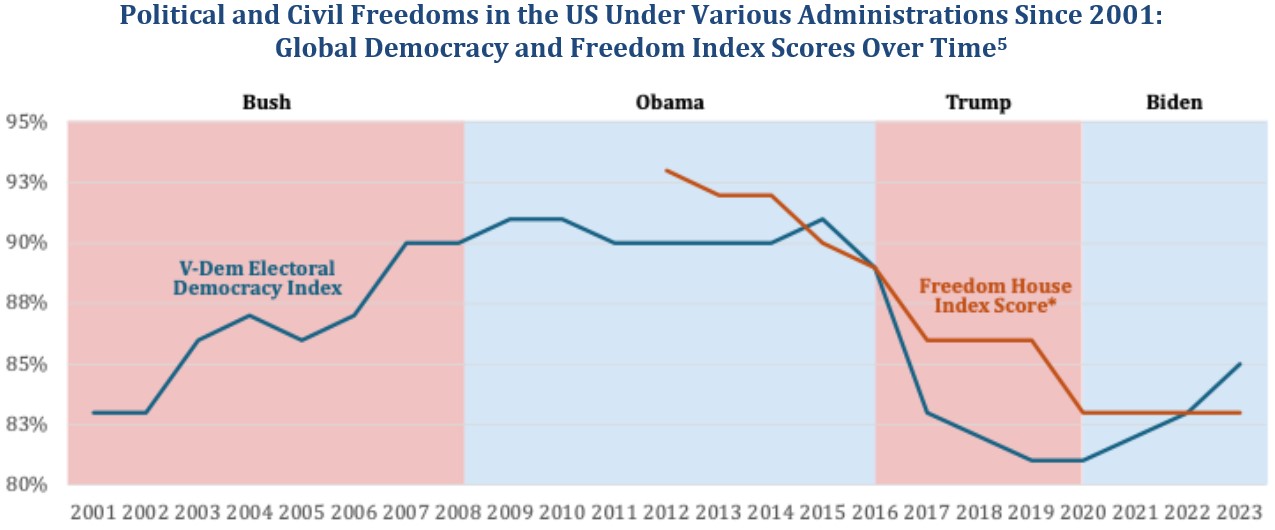
Context. The US’ score and ranking in globally-recognised indices which measure the degree of political and civil freedoms has declined over the last decade due to the erosion of its democratic institutions as a result of “rising political polarisation and extremism, partisan pressure on the electoral process, mistreatment and dysfunction in the criminal justice and immigration systems, and growing disparities in wealth, economic opportunity, and political influence.”4 This accelerated during the Trump Administration and culminated with the 6th January insurrection with the US dropping to its lowest levels across indices. While some scores suggest that this has partially recovered under President Biden, clearly, with a large proportion of the electorate believing that the 2020 election was “stolen” from Donald Trump, US democracy remains in a precarious position. This election will therefore be pivotal for the strength of US democratic institutions, particularly in light of the US Supreme Court’s recent ruling granting immunity to presidents from prosecution for acts committed in their “official capacity”.
In the Candidates’ Words
“We will fight to safeguard our democracy. We will fight to secure our most fundamental freedom: the freedom to vote … Anti-voter laws are not new in our nation, but we must not be deceived into thinking they are normal … The assault on our freedom to vote will be felt by every American, in every community, in every political party. And if we stand idly by, our entire nation will pay the price for generations to come.” Kamala Harris in a speech (Jan-2022)6
“I think the bigger problem is the enemy from within. All the scum that we have to deal with that hate our country, that’s a bigger enemy that China and Russia… We have some very bad people. We have some sick people, radical left lunatics. And I think it should be very easily handled by, if necessary, the National Guard or, if really necessary, the military, because they can’t let that happen.” Donald Trump in an interview with Fox News (Oct-2024)7
7Potential Implications of the Election, for America and the World
A Harris Victory would likely ensure continuity (and potentially strengthening) of US democratic institutions, and globally see continued US support for democratic leaders vs. authoritarians.
A Trump Victory could lead to a further weakening of democratic institutions in the US as he seeks to expand his power, while emboldening authoritarians abroad.
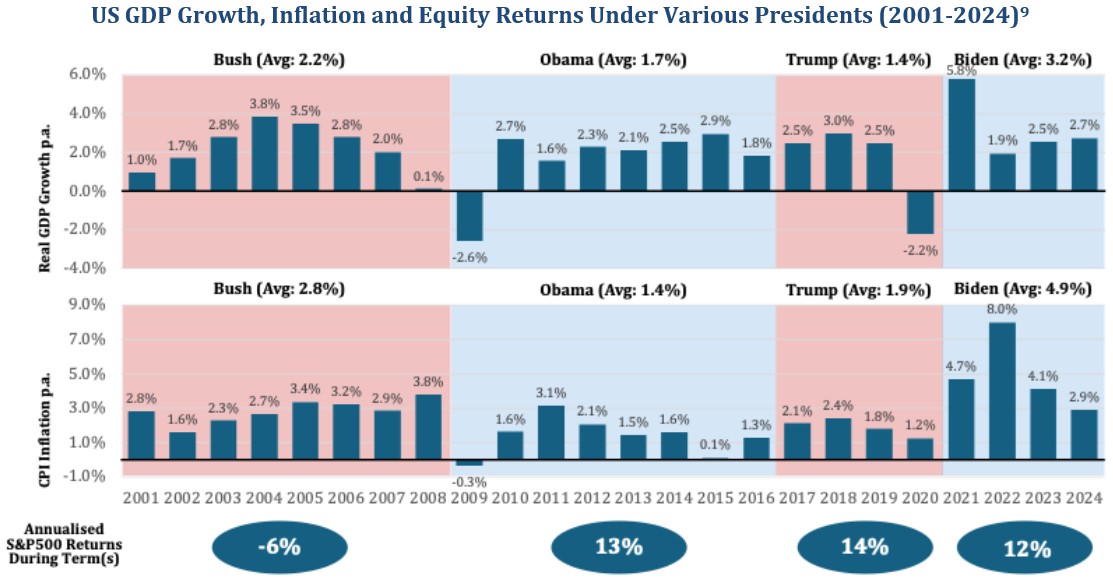
Context. Under President Biden, the US economy has recovered from the pandemic and demonstrated resilience even as it faced high inflation and volatile equity markets. Recent employment figures and the Federal Reserve decision to start lowering interest rates suggest potential for continued strong performance with the economy projected to grow at over 2% p.a. for the rest of the decade8, as long as economic and financial stability is maintained. As the largest economy, importer and international investor globally, the strength of the US economy and financial system continues to be a major driver of macroeconomic growth and stability for most developed and developing countries.
In the Candidates’ Words
“I believe we need to grow our middle class and make sure our economy works for everyone... I will recommit the nation to global leadership in sectors that will define the next century… History has shown it time and again: When we invest in those things that strengthen the middle class — manufacturing, housing, health care, education, small businesses, and our communities — we grow our economy and catalyze the entire country to succeed.” Kamala Harris in a speech to the Economic Club of Pittsburgh (Sep-2024)10
“My plan will rapidly defeat inflation, quickly bring down prices and reignite explosive economic growth. I am promising low taxes, low regulations, low energy costs, low interest rates ... Companies that outsource will be subject to tariffs … We're going to impose tariffs of 20% to 60% on Chinese products and anything that they send over here that takes away our jobs. If you do business with China, you’re going to pay a price.” Donald Trump in a speech to the Economic Club of New York (Sep-2024)11
Potential Implications of the Election, for America and the World
A Harris Victory would likely lead to a continued focus on policies to strengthen the middle class with targeted investments in industries; expansion of social programs and minimum wages could lead to inflationary pressures.
A Trump Victory would likely lead to a focus on deregulation and tax cuts for wealthy and corporations as a primary driver of growth, though his proposed tariffs are expected to lead to inflation and potentially economic and market issues12.
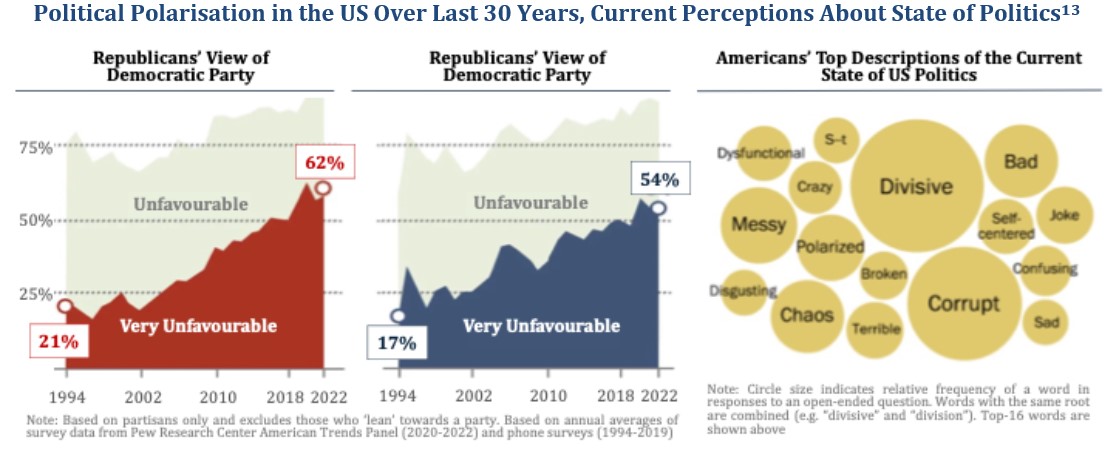
Context. Political polarisation in the US has worsensed sharply over the last 2-3 decades, with successive closely fought elections revealing an electorate that is nearly evenly divided between two seemingly irreconcilable world views on everything. Increasing polarisation is apparent across both Democratic and Republican administrations and seems to have become deeply entrenched due to several factors including redistricting (or gerrymandering), a divisive primary structure which encourages candidates to espouse extreme positions, the echo chamber created by social media and the deep socio-economic divisions between different parts of the country. While a few politicians have sought to bridge the divide (usually unsuccessfully), many others have cynically played to the divisions and the bases to build their political strength.
In the Candidates’ Words
“I was raised in a community of folks who understood that when we stand together, when we look for commonality, that’s when we thrive. I love good ideas, wherever they come from. What I intend to do is [create] a bipartisan council of advisers who can give feedback on policy … For us to maintain our status as the strongest democracy in the world, we need a healthy two-party system. I think on the fundamentals, we have more in common than what separates us.” Kamala Harris in a speech at a rally in Arizona (Oct-2024)14
“They rigged it like they’ve never rigged an election before. All of us here today do not want to see our election victory stolen by radical-left Democrats and the fake news media. We will never concede… Our country has had enough. We will stop the steal… And we fight. We fight like hell. And if you don’t fight like hell, you’re not going to have a country any more. So we’re going to walk down Pennsylvania Avenue… and we’re going to the Capitol.” Donald Trump in a speech to his supporters in on 6th January, 202115
Potential Implications of the Election, for America and the World
A Harris Administration would likely focus on bipartisan rhetoric and legislative intiatives to build political support to get legislation through a closely divided Congress.
A Trump Victorywould likely mean, judging by previous history, continued use of divisive rhetoric and playing to the base, while creating new antagonists.
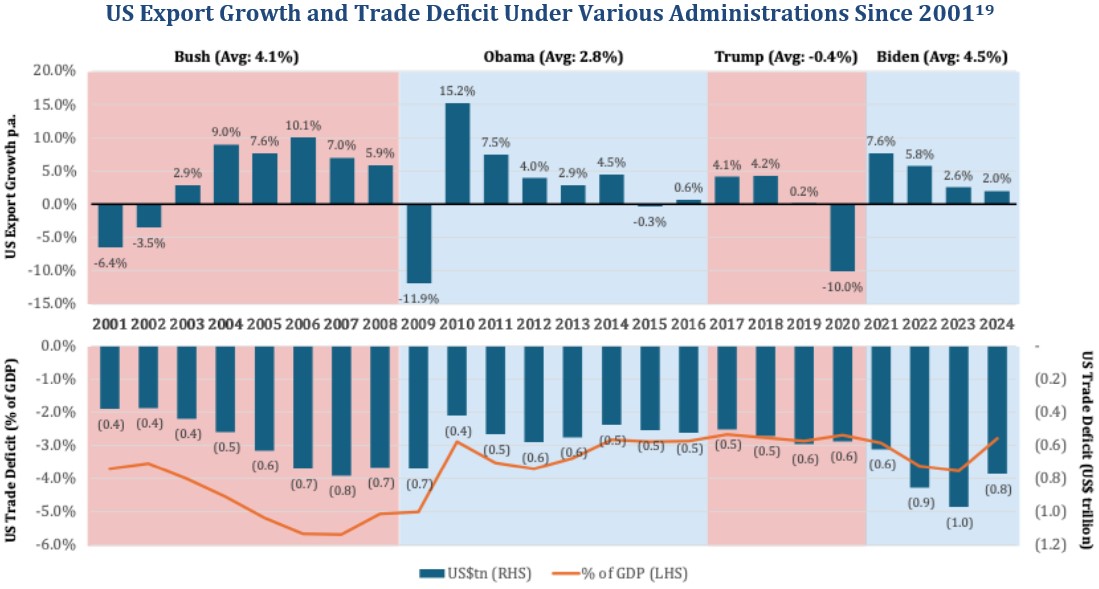
Context. While the total value of global trade has risen nearly five-fold since the beginning of the century (from US$7 trillion to US$31 trillion)16, US trade has also grown but not kept pace, with the country running a persistent trade deficit of c.3-4% of GDP, driven in large part by its relationship with its largest trading partner, China. The Trump Administration liberally used tariffs on various goods from both partners and rivals, and increased domestic inflation, invited retaliatory tariffs and led to an escalating trade war with China, which led to some degree of trade decoupling17, though with increased costs of which were ultimately borne by US taxpayers through higher prices18 . The Biden Administration has continued some of these tariffs, however applied them in a more targeted manner to protect certain industries and strategic interests (for example, advanced technology).
In the Candidates’ Words
“I will oppose any trade deal that doesn’t look out for the best interests of American workers and raise environmental standards and unfortunately the [Trans Pacific Partnership] did not pass that test. I would work with our allies in Europe and Asia to confront China on its troubling trade practices, not perpetuate Trump’s failing tariff war that is being paid for by hard-working Americans.” Kamala Harris at a debate about the Trans Pacific Partnership (Jul-2019)20
“The higher the tariff, the more likely it is that the company will come into the United States and build a factory in the United States, so it doesn’t have to pay the tariff. The tariff you make it so high, so horrible, so obnoxious, that they’ll come right away.” Donald Trump in an interview with Bloomberg News while discussing his plans to impose a 20% tariff on all goods from all countries, with a specifically high 60% rate on Chinese imports (Oct-2024)21
Potential Implications of the Election, for America and the World
A Harris Administration would likely use tariffs in a targeted manner to protect strategic interests while directing trade policy in a manner that protects American jobs, intellectual property and global environmental interests.
A Trump Administration would likely use tariffs aggressively, both against China but others too, as he did in the first administration, inviting retaliatory action and disrupting global trade linkages.
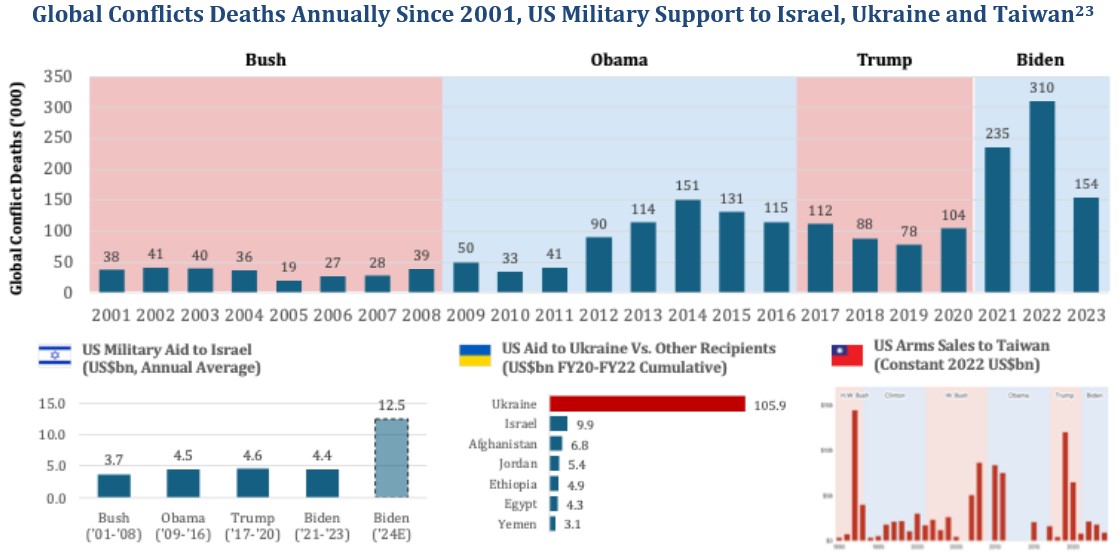
Context. In recent years, two major wars have erupted: Russia’s 2022 invasion of Ukraine, which prompted material U.S. and European military support, and Hamas' surprise attack on Israel, which was followed by an Israeli war in Gaza and conflict with Hezbollah in Lebanon, alongside skirmishes with Iran. As a result, global conflict deaths are at their highest levels this century. Beyond these wars, potential flashpoints like Yemen, India-Pakistan, and the China-Taiwan situation remain concerning. The Biden Administration has employed a dual strategy, backing Israel militarily while urging diplomatic restraint to prevent a wider conflict, which seems not have had much affect thus far. Meanwhile, Donald Trump has criticized military aid to Ukraine, promising a swift end to the war22.
In the Candidates’ Words
“We cannot conflate Hamas with the Palestinian people. As Israel pursues its military objectives in Gaza, we believe Israel must do more to protect innocent civilians … International humanitarian law must be respected. Too many innocent Palestinians have been killed.” Kamala Harris in a speech in Dubai (Dec-2023)24
“The United States supports Ukraine not out of charity, but because it’s in our strategic interest.” Kamala Harris in official remarks after a meeting with President Zelensky25
“If I were President, I will end that war in one day. I know Zelensky well, I know Putin well, I would get a deal done. That deal would be easy. A lot of it has to do with the money. A lot of it has to do with the military aid we are giving.” Donald Trump in an interview with The Times (May-2023)26
He [President Zelensky] just left four days ago with US$60 billion, and he gets home, and he announces he needs another US$60 billion. It never ends.” Donald Trump at a campaign rally in Detroit Michigan (Jun-2024)27
Potential Implications of the Election, for America and the World
A Harris Victory would likely mean a continuation of US support to Ukraine and continued efforts to urge restraint by Israel, while diplomatic channels are leveraged to prevent further escalation into a broader regional conflict.
A Trump Victory would likely mean an end to the US’ military support for Ukraine which in turn may force Ukraine to capitulate to Russia’s terms, even as he strongly backs Israel and President Netanyahu in escalating conflict across the region.
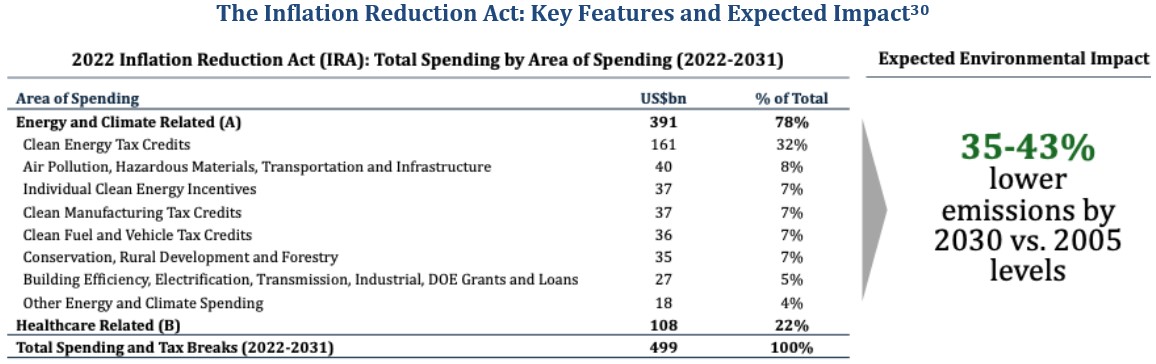
Context. Climate change has now reached dangerous levels and with increasing extreme weather events, climate action can ill-afford to be postponed. At the same time, beyond climate change, other UN SDGs related to addressing basic human needs, funding infrastructrure, and creating shared global prosperity are chronically underfunded and at serious risk of being missed. The Biden Administration appears to have recognised the scale of the emergency and has responded by engaging other countries and stakeholders to elicit emissions commitments, while demonstrating its own intent by passing the Inflation Reduction Act, potentially one of the biggest pieces of climate legislation the world has seen, which has authorised c.US$500 billion of incremental spending and investment, 80% of which is towards climate change and energy security28, and has the potential to lower US emissions by 35-43% below 2005 levels, by 203029. Donald Trump has made his strong support for fossil fuels and skepticism of climate science clear, and also criticised multilateral frameworks like the Paris Agreement which he believes are at odds with an “America First” approach.
In the Candidates’ Words
“ As a global community, it is imperative that we act quickly and together to confront this crisis. And this will require innovation and collaboration around the world. It will require the use of renewable energy and new technologies. And it will give each of our nations the opportunity to build healthier communities and stronger economies.” Kamala Harris statement at Leaders Summit on Climate (Apr-2021)31
“The Paris Climate Accord is simply the latest example of Washington entering into an agreement that disadvantages the United States to the exclusive benefit of other countries, leaving American workers — who I love — and taxpayers to absorb the cost in terms of lost jobs, lower wages, shuttered factories, and vastly diminished economic production… the United States will cease all implementation of the non-binding Paris Accord and the draconian financial and economic burdens the agreement imposes on our country.” Donald Trump official statement (Jun-2017)32
Potential Implications of the Election, for America and the World
A Harris Administration would likely lend greater support to multilateral efforts to tackle climate change and SDG achievement and the funding gap, fostering greater global collaboration.
A Trump Administration would likely seek to roll back parts of the Inflation Reduction Act, withdraw from tUS international climate commitments, and is unlikely to look to focus on developing country SDG funding gaps.
Context. During his administration, President Donald Trump is widely seen as having upended decades of US alliances by sharply shifting towards his “America First” policy which prioritised securing American interests through bilateral engagement, eschewing multilateral coordination on security or development related matters, and adopting a more transactional approach with the US’ strongest allies in Europe, questioning US funding to NATO. There has been an uptick in European country funding of NATO which detractors say is a reaction to cumulative pressues and the war in Ukraine, and fans say was due to the Trump’s threats. Trump also promoted the breakup of the EU with support for the UK Brexit. Trump’s approach led to some disengagement with multilateral institutions like the UN and strained alliances more widely, it also saw continued strong relations with India. On the Middle East,the Abraham Accords advanced peace deals between Israel and the Middle East sovereigns, declaring the shift of the US embassy to Jerusalem, which were seen to go against Palestinian statehood33, and detractors would argue foreshadow the conflict today34.
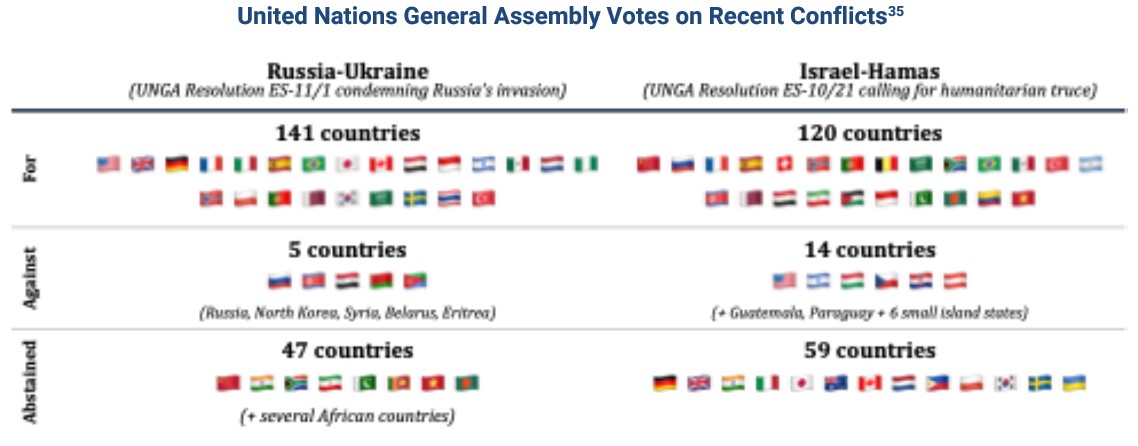
The Biden Administration has looked to rebuild the transatlantic alliances, signalled no support for the UK in fracturing the EU, while re-engaging with multilateral organisations and leveraging American influence to drive global coordination on key issues including climate change and security. However, the last few years have seen two major wars erupt with the UN Security Council powerless to stop them, and the US finding its interests increasingly at odds with major global powers, for example with India and China both abstaining from the UN resolution condemning Russia’s invasion of Ukraine, and nearly 180 countries (including major European allies, all BRICS countries, Japan and others) opposed the US and Israel in the UN resolution calling for humanitarian truce in Gaza. The Biden Administration has seen itself ineffective at bringing Israel’s expansion of its conflict to a meaningful rest for itself or others, and this has put its power into question.
In the Candidates’ Words
“ I believe it is in the fundamental interest of the American people for the United States to fulfill our longstanding role of global leadership… we are committed to pursue global engagement, to uphold international rules and norms, to defend democratic values at home and abroad, and to work with our allies and partners in pursuit of shared goals.” Kamala Harris statement at Munich Security Conference (Feb-2024)36
“India, of course, is a very important partner to the United States. Throughout our history, our nations have worked together, have stood together to make our world a safer and stronger world.” Kamala Harris remarks before bilateral meeting with Narendra Modi (Sep-2021)
“For decades, the same tired voices proposed the same failed solutions, pursuing global ambitions at the expense of their own people. But only when you take care of your own citizens, will you find a true basis for cooperation. As President, I have rejected the failed approaches of the past, and I am proudly putting America first, just as you should be putting your countries first..” Donald Trump statement to UN General Assembly (Sep-2020)37
“Together, the United States and India will provide strong leadership to address global challenges and build prosperity for their citizens in the decades to come.” Donald Trump in official joint statement with Narendra Modi after latter’s state visit to Washington (Jun-2017)
Potential Implications of the Election, for America and the World
A Harris Administration would likely continue the US’ engagement with multilateral institutions as a means to project American influence, while looking to strengthen strategic alliances with Europe and India.
A Trump Administration would likely revert to the America First approach of bilateral and transactional relationships with allies, while disengaging with multilateral institutions on critical issues.
Conclusion: What a Trump Vs. Harris Presidency Could Look Like for the World
As the analysis above suggests, a Trump presidency vs. a Harris presidency would look very different for both America and the world in terms of the potential trajectories the world could take with respect to the critical challenges it faces today, including global conflicts, climate change and rising inequality. While it is impossible to predict the specific policies, the candidates’ own track record and past statements provide an important indication of what each one’s presidency could look like.
Under Donald Trump: A More National Populist Approach to Deploying American Power, Dividing, Fragmenting and Competiting as a Strategy. Trump’s vision of the world sees America exercising its power overtly in favour of America in its transacitons with the world, where all others – allies and competitors – are counterparties. Such protectionist trade policies and bilateral (rather than multilateral) engagement likely lead to a more fragmented global economy, and potentially escalate trade wars that could disrupt global supply chains and lead to financial market volatility. The US-China rivalry would in all likelihood intensify, with countries forced to take sides, even as multilateral institutions are weakened due to US disengagement. The US would likely prioritise fossil fuels and withdraw from any global climate or SDG related commitments, leaving the pursuit of these objectives to other countries, the private sector and civil society organisations. China may potentially look to fill the void left by the US. Domestically, Trump’s stance on immigration and identity-based politics could further stoke internal divisions and increase tensions between different ethnic groups. The trajectories of the wars in Europe and the Middle East would also likely shift given Trump’s likely withdrawal of military assistance to Ukraine and potentially unmitigated support for Israel’s war efforts. Domestically, America can be expected to continue to splinter economically, socially and politically, deregulate to allow larger monopolies to build and consumer protections to fall, innovation would rise and lose to monopolies, a more raw form of capitalism would prevail, and income inequality would likely rise further. However, domestic economic and market gains from volatility and extracting value from the world may well be substantial in the short term, while shoring up a longer term challenge for American power and influence. This approach would likely make the transition from the Industrial to the Information Era riskier given it does not take the world with it.
Under Kamala Harris: A More Multilateral, Inclusive and Cooperative Approach, Uniting, Sharing and Cooperating as a Strategy for Disarming Resistance to American Power. Harris would likely offer continuity on most matters with the Biden Administration, pursuing a more multilateral approach and building the US’ strategic alliances. Tariffs may still be used, but in a more targeted and strategic manner, leading to global macroeconomic stability and fostering global collaboration on issues like technology (and AI) regulation and climate change. Harris’ multilateral approach would likely strengthen global institutions and restore US leadership of these, using them as a means to drive collaboration between countries and other stakeholders on climate change and the SDGs, and global security. Domestically, a Harris Administration would likely make some attempts at bipartisanship and focus on addressing core freedoms (e.g. abortion rights) and social justice issues (e.g. gun reform and criminal justice reform), but would be unlikely to succeed in uniting the nation given the depth of the divisions. The trajectories of the Russia-Ukraine war and Middle East conflict are unlikely to shift significantly with continuity in US support for Ukraine and qualified support for Israel. Its challenge would be to be more effective than the Biden Adminstration at resolving fundamental differences on the two wars, on the domestic local fossil fuel lobby and the shift to renewables, recognising that both are part of the transition but the direction to clean energy is the way ahead, boosting American industrial and technological leadership while create competition despite the oligopolistic nature of many of its industries. If successful, America would be well placed to build a strategic alliance with the EU and India which would see it as a “first among equals” in the face of China, which even at low growth rates is a rising power to reckon with. Importantly, cooperation allows for a smoother and less risky transition to the Information Era.
As discussed in last month’s Sign, a transactional approach risks undermining the trust that underpins America's leadership in shaping a secure, prosperous, and free world. If internal divisions persist, they could weaken the US as has happened to great powers throughout history. To maintain its global influence, America must firstly be a stable and united nation, and that is in doubt. If that were secured, it faces a critical decision on the nature of its leadership. One choice is based on the belief that its advantage is so great that it feels cooperation is unnecessary. The alternative, which has underpinned America’s history abroad through wars and peace, is to feel that the best way to use that advantage is by sharing enough of its fruits such that others follow willingly. The first lends itself to brute force and the second to a more subtle style of global leadership. The upcoming election is a turning point for US power since the world is entering the Information Age, bringing great new opportunities for global prosperity. The election will reveal the nature of American leadership in this next phase.
The Leader: Endnotes
-
Source: https://projects.fivethirtyeight.com/2024-election-forecast/
-
Pennsylvania (19 electoral votes) + Georgia (16) + North Carolina (16) + Michigan (15) + Arizona (11) + Wisconsin (10) + Nevada (6) = 93 electoral votes (or 17% of total)
-
Source: 2024 Capital as a Force for Good report
-
Source: Freedom House, Freedom in the World Report, 2024 US Country Report
-
Sources: Freedom House, Freedom in the World reports 2012-2023; Varieties of Democracy (V-Dem) Project database
-
Source: White House, https://www.whitehouse.gov/briefing-room/speeches-remarks/2022/01/11/remarks-by-vice-president-harris-on-protecting-the-right-to-vote/
-
Source: Washington Examiner, https://www.washingtonexaminer.com/policy/defense/3189349/the-enemy-from-within-trump-suggests-using-the-military-to-protect-the-nation-from-radical-left-lunatics-protesting-his-election-victory/
-
Source: IMF World Economic Outlook, October 2024
-
Sources: IMF World Economic Outlook database (October 2024), S&P
-
Source: White House, https://www.whitehouse.gov/briefing-room/speeches-remarks/2024/09/25/remarks-by-vice-president-harris-at-a-campaign-event-pittsburgh-pa/
-
Source: https://singjupost.com/full-transcript-trump-speaks-at-the-economic-club-of-new-york/?singlepage=1
-
Source: Goldman Sachs research note, as reported by Bloomberg, https://www.bloomberg.com/news/articles/2024-09-03/goldman-sees-us-gdp-hit-from-trump-win-boost-if-democrats-sweep
-
Source: Pew Research Center, https://www.pewresearch.org/politics/2023/09/19/americans-dismal-views-of-the-nations-politics/
-
Source: White House, https://www.whitehouse.gov/briefing-room/speeches-remarks/2024/10/11/remarks-by-vice-president-harris-at-a-campaign-event-scottsdale-az/
-
As transcribed by the Associated Press, https://apnews.com/article/election-2020-joe-biden-donald-trump-capitol-siege-media-e79eb5164613d6718e9f4502eb471f27
-
Source: UNCTAD Trade database
-
Source: Peterson Institute for International Economics, https://www.piie.com/blogs/realtime-economics/four-years-trade-war-are-us-and-china-decoupling
-
Source: Jin, Keyu (2023). The New China Playbook: Beyond Socialism and Capitalism. New York: Viking. ISBN 978-1-9848-7828-1.
-
Source: IMF World Economic Outlook, US Bureau of Economic Analysis (BEA)
-
Source: Council on Foreign Relations (CFR), https://www.cfr.org/article/presidential-candidates-trans-pacific-partnership
-
Source: CNBC, https://www.cnbc.com/2024/10/20/trump-tariffs-election.html
-
Source: Associated Press (Sep 2024), https://apnews.com/article/donald-trump-ukraine-putin-zelenskyy-0f4d539aa73a943474d779716e5fe42a
-
Sources: Uppasala Conflict Data Program (2024), Council on Foreign Relations (based on data from USAID, Congressional Research Service, Department of Defence, and Bureau of Economic Analysis) https://www.cfr.org/article/us-military-support-taiwan-five-charts https://www.cfr.org/article/us-military-support-taiwan-five-charts https://www.cfr.org/article/how-much-us-aid-going-ukraine
-
Source: White House, https://www.whitehouse.gov/briefing-room/speeches-remarks/2023/12/02/remarks-by-vice-president-harris-on-the-conflict-between-israel-and-hamas/
-
Source: PBS, https://www.pbs.org/newshour/world/watch-harris-meets-with-ukraines-zelenskyy-as-russia-makes-nuclear-warning
-
Source: The Times and Sunday Times youtube channel, https://www.youtube.com/watch?v=_fEbGppH86M
-
Source: Politico, https://www.politico.eu/article/donald-trump-ukraine-russia-war-threatens-cut-aid-election-2024/
-
Source: Congressional Budget Office (CBO), https://www.crfb.org/blogs/cbo-scores-ira-238-billion-deficit-reduction
-
Source: US Environmental Protection Agency (EPA), https://www.epa.gov/inflation-reduction-act/electric-sector-emissions-impacts-inflation-reduction-act#:~:text=The%20Inflation%20Reduction%20Act%20lowers,below%202005%20levels%20in%202030.
-
Source: CBO and EPA
-
Source: White House, https://www.whitehouse.gov/briefing-room/speeches-remarks/2021/04/22/remarks-by-vice-president-harris-at-the-virtual-leaders-summit-on-climate-opening-session/
-
Source: Trump White House Archives, https://trumpwhitehouse.archives.gov/briefings-statements/statement-president-trump-paris-climate-accord/
-
Source: Times of Israel article, May 2018
-
Source: Council on Foreign Relations, https://www.cfr.org/backgrounder/what-us-policy-israeli-palestinian-conflict
-
Source: CBO and EPA
-
Source: White House, https://www.whitehouse.gov/briefing-room/speeches-remarks/2021/04/22/remarks-by-vice-president-harris-at-the-virtual-leaders-summit-on-climate-opening-session/
-
Source: United Nations meeting transcripts, https://estatements.unmeetings.org/estatements/10.0010/20200922/cVOfMr0rKnhR/cJHrXk2KdRU8_en.pdf


