
As 2024 ends, there are only six years remaining until the 2030 deadline to achieve the UN Sustainable Goals’ (SDGs). Only 16% of the SDG targets are on track and a third of them have regressed below 2015 levels. The recent US election has cast a shadow over the SDGs and global climate goals with the world’s largest emitter and funding source expected to withdraw from global climate engagement, reduce climate funding and double down on fossil fuels.
The Global South faces the most acute challenge. The SDG funding gap in developing countries has grown to at least US$4 trillion annually, and is potentially as high as US$11-12 trillion annually when the full scope of the SDGs’ climate, economic, social and infrastructure requirements is taken into account. Developing countries are burdended by debt and have limited public finances to cope with this requirement internally, despite their per capita emissions being significantly lower than developed countries’. External funding is therefore critical for them to achieve the SDGs and global climate goals.
Blended finance – the application of outcome-focused climate finance or development capital at concessional terms to attract private investment – is widely being seen as the most promising answer to this challenge. It is potentially a more scalable solution vs. other SDG funding sources including official development assistance (ODA), philanthropic capital and impact investments. Multilateral development banks (MDBs) and development finance institutions (DFIs) are increasingly using blended finance structures and focusing on mobilising private capital.
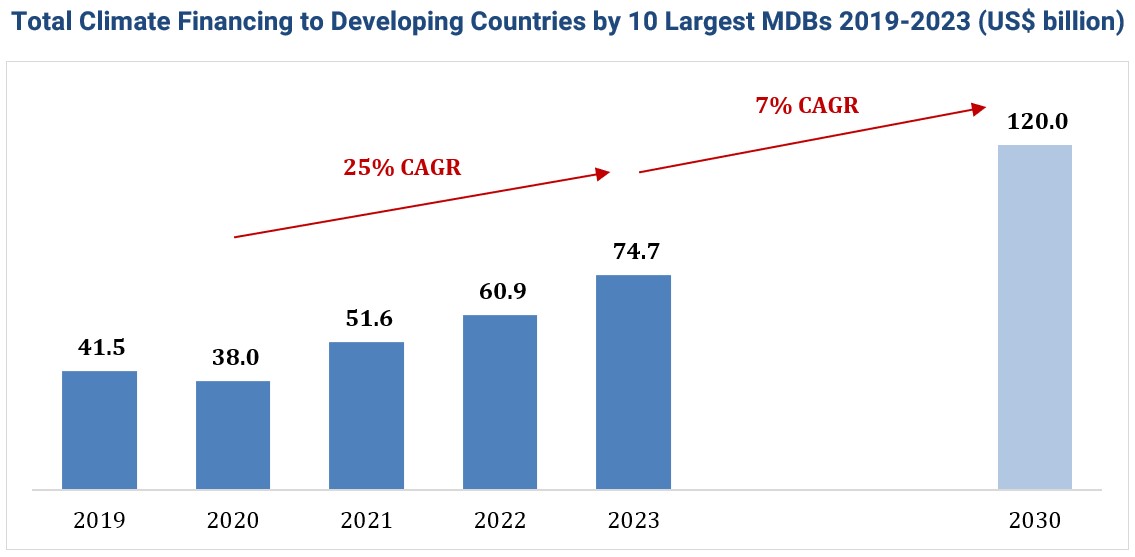
However, the total quantum of concessional funding is still inadequate and the rate at which private capital is mobilised is significantly below needs. For example, total climate financing from the largest MDBs to developing countries in 2023 was US$75 billion, and each dollar invested by them mobilised only US$0.92 of private and public capital1. At these rates, without a significant and rapid scale up, blended finance’s relevance is questionable for meaningfully reducing the SDG funding gap in the limited time available.
This month’s Sign examines the fundamental question of whether blended finance is the solution to the world’s levelling up that it is promised to be, whether it can potentially be, and what it would take for it to move the needle on the SDGs.
Context: The SDG Funding Gap in Developing Countries
Recent UN estimates indicate that the funding gap to acheieve the SDGs in developing countries has increased from US$2.5 trillion to US$3.8-4.3 trillion annually, due to continued underinvestment and additional needs, particularly in the energy and water and sanitation sectors2.
As highlighted in the 2024 Capital as a Force for Good report3, the full extent of the gap may be as high as US$11-12 trillion annually when all climate, human and economic development related, and infrastructure needs are taken into account. The report also highlights the following4 :
-
Growing SDG Delivery Gap. Only 16% of the SDG targets are on track, half are moderately or severely off track and a third have regressed below 2015 levels, as a series of crises have deepened global development and climate challenges.
-
Inadequate Capacity for Global South to Self Fund the SDGs. Developing countries are not in a position to fund the massive SDG funding gap given their high levels of indebtedness and stretched public finances.
-
Vast Majority of Global Capital is Focused on Maximising Return. 84% of global liquid wealth of US$433 trillion is held by private individuals and corporations who are focused on maximising return for risk, not global development goals.
-
Private Funding for SDGs Limited Given Risk Return Gap. SDG funding opportunities struggle to match traditional financial structures, and need to be more commercially viable to attract private capital at scale (or a shift in incentive structure which better values SDG outcomes).
The results of the recent US election could potentially worsen the challenge of financing the SDGs. The US is widely expected to withdraw from the Paris Agreement again, reduce its domestic and international climate commitments and engagement, prioritise investments in fossil fuels and loosen environmental regulations5. This may potentially include rolling back the Inflation Reduction Act which mobilised US$500 billion for climate investments6 and has the potential to lower US CO2 emissions by 35-43% by 2030 vs. 2005 levels7 .
In this context, other major emitters may also decide to adopt a “country first” approach at a time when increased multilateral engagement, coordination and investment are required to address the SDG funding gap and escalating climate crisis. The recent COP29 meeting highlighted these concerns with bitter debates for meagre progress, in this case a commitment to increase climate financing to developing countries to US$300 billion annually8 versus an ask of over US$1 trillion annually9, and other power blocs like China and Europe looking to step into the leadership vacuum that they feel will be left by the US.
A UN analysis of such a scenario, called “SSP-5: Fossil Fueled Development”10, suggests that an all out bet on fossil fuels by major countries may yield higher economic growth which allows developing countries to invest in climate change adaptation and the world to invest in technological innovation to find cleaner energy sources11. However this would require strong international cooperation, timely innovation breakthroughs and cross-border investment and technology transfers from developed countries to the Global South. This seems unlikely to happen in a scenario where the US eschews multilateralism in favour of transactional bilateral relationships.
If the US indeed withdraws from global engagement, other stakeholders will need to step up to fill the void (at least for the next four years), to try and ensure other countries’ climate targets, are funded and met, in particular in developing countries, a tall order for a world addicted to US leadership.
The Promise and Limitations of Blended Finance
Blended finance is seen by most development finance experts as the most scalable solution to funding the SDGs in developing countries12, because it seeks to mobilise private capital by supporting returns or mitigating risks of projects for the private sector through tools such as concessional rate loans, grants, and first-loss guarantees. Blended finance has shown how it can be effective in derisking projects and attracting private sector investment in areas such as renewable energy and infrastructure13.
Strictly defined, blended finance is a narrow market currently, mobilising c.US$15bn annually towards climate and development projects in developing countries14. The typical ratio of non-concessional to concessional capital in these projects is c.4:1, however, only c.50% of this non-concessional funding is from the private sector, with the remainder coming from MDBs and DFIs themselves15. This suggests that the actual ratio of funding from private source vs. MDBs and DFIs is c.2:3 (i.e. every dollar of MDB/DFI funding mobilises c.US$0.67 of private funding).
Looked at more broadly, blended finance can be considered as the application of both concessional and non-concessional funding from MDBs/DFIs and other outcome funders in order to mobilise private capital. In this context, total climate financing from the largest MDBs to developing countries has grown from US$38 billion in 2020 to US$75 billion in 2023, at a 25% CAGR16. These MDBs have pledged at COP29 to increase this to c.US$120 billion by 2030, and to raise another US$65 billion of private funding for developing countries from the private sector alongside theirs17. This is part of the broader developed country commitment at COP29 to increase overall climate funding to developing countries from US$100 billion to US$300 billion by 2035.
However, the total quantum of private financing mobilised in 2023 in these climate projects was only US$29 billion, or US$0.38 for every dollar invested by the MDBs, with another US$40 billion mobilised from public financing (e.g. from recipient country governments)18. This is consistent with another recent analysis of a larger pool of MDBs and DFIs which found that the total private sector capital mobilised directly and indirectly by them in 2023 was c.US$71 billion19, less than 1.0x the total climate funding number. The 2030 target announced by the MDBs suggests that they do not believe this ratio will increase much (see table below).
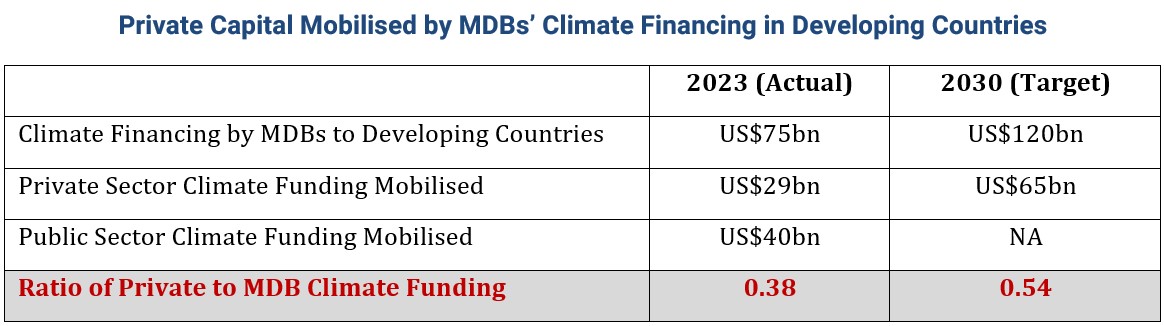
At these levels, there is neither enough concessional funding, nor an adequate mobilisation of private capital to make a meaningful difference to the developing countries’ SDG funding gap.
Scaling Blended Finance: What Will it Take for it to Fund the SDG Funding Gap?
What would it take for blended finance to meaningfully fund the developing countries’ SDG funding gap? At a base level, to fund the lower end estimate of US$4 trillion, overall concessional and catalytic funding would need to increase to c.US$0.8 trillion annually, and the 4:1 ratio of non-concessional to concessional capital on current blended finance deals would need to be maintained, mobilising c.US$3.2 trillion of private capital. However, at these levels, a c.US$7-8 trillion funding gap may remain unfunded if considering the upper end estimate of the gap from the 2024 Capital as a Force for Good report.
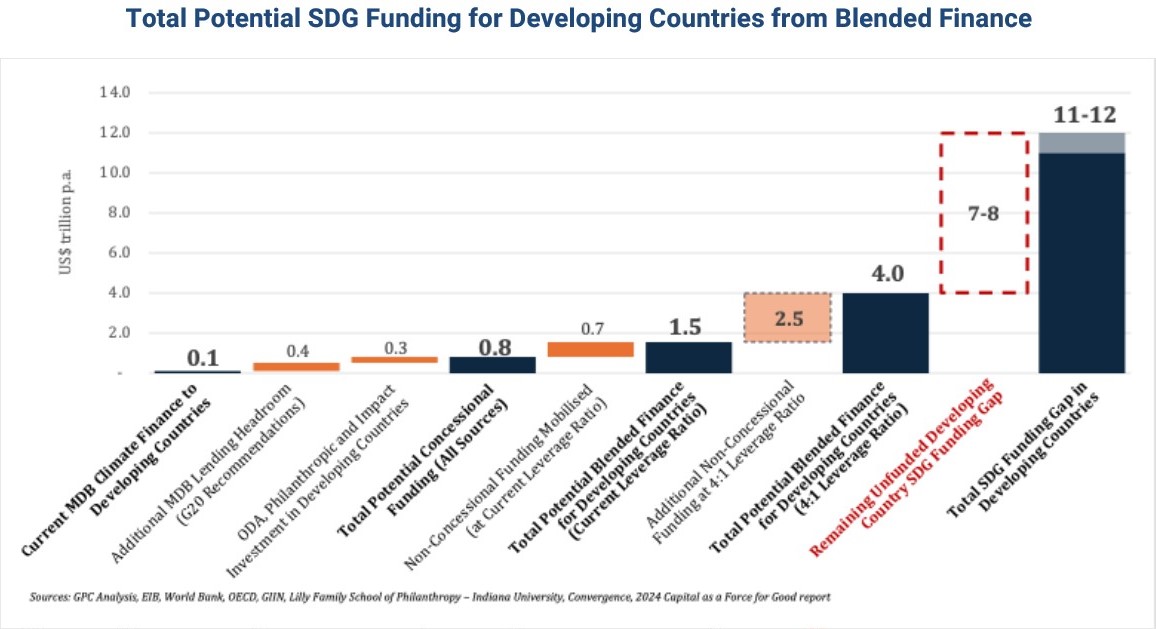
Closing this gap will require strategies to rapidly and significantly scale up concessional funding from MDBs and other sources and, more importantly, increase the rate of capital mobilisation from the private sector. There are five strategies that can contribute to closing the gap.
Rapidly Scale Up MDB Funding Capacity and Concessional Financing to Developing Countries. MDB balance sheets appear to be underleveraged. Analysis suggests that the World Bank Group (the largest of the MDBs accounting for c.50% of climate funding to developing countries) and other MDBs could potentially double their lending capacity by relaxing risk parameters20. G20 nations have already called on the MDBs to implement various measures21 to increase their capitalisation, and increase their lending headroom by c.US$360 billion over the next decade22. If this incremental financing capacity were allocated to blended finance instruments developing countries, this could increase the total quantum of funding from MDBs to developing countries to c.US$0.5 trillion annually.
Tap into Flows of Other Flows of Capital for Concessional Funding. There are other pools of capital for funding development and climate outcomes in developing countries which can potentially be coopted as concessional capital in blended finance deals, however, each of these faces challenges in scaling as a major source of funding to reduce developing countries’ SDG funding gap. These include:
-
Official development assistance (ODA) from developed to developing countries has grown to US$217 billion annually23, but most of this is bilateral in nature and constrained by geopolitical priorities and domestic budget pressures. Between 2018 and 2023, only US$1 billion of ODA cumulatively has been used as concessional capital in blended finance deals24.
-
Cross-border philathropic investment is estimated to be c.US$70 billion annually25, with US-based donors accounting for c.US$50 billion of this and much of this can be leveraged in blended finance. However philanthropic contributions are fragmented and focused on various causes (with the largest recipients being religious organisations).
-
Impact investing is explicitly focused on sustainable development and has grown rapidly as an asset class to reach US$1.4 trillion of AUM26, with annual investment flows of c.US$62-95 billion annually, however only 25% of this capital is allocated to developing countries, with the rest focused on impact opportunities in developed countries27.
Collectively, these three sources could contribute an additional c.US$300 billion of concessional outcome-oriented funding annually for the SDGs, if they were fully coopted into impact outcome linked blended finance structures.
A Focus on Fewer, Larger and More Bankable Projects. Larger blended finance projects of over US$500 million have proven to have a higher rate of private capital participation28, however, much of blended finance is focused on a wide range of small-scale and unrelated objectives, with smaller projects typically having worse risk and/or return parameters, and requiring a higher proportion of MDB capital to attract private investors. A shift in focus towards pooling resources for larger and more bankable SDG funding opportunities can help mobilise private capital at a much higher rate.
Transfering Solutions and Financing Linked to Improving Business Environments. To attract private capital on a long-term and sustainable basis, developing countries need to improve their business environments and reduce the macro risks of SDG projects, which inevitably get priced into funders’ risk and return expectations, increasing the amount of concessional funding required for projects. Linking both financing, and transfer of technology and other solutions, to tangible policy changes by recipient governments can therefore help reduce risk and improve returns for these projects.
Targeting Scaled Blended Finance at Sectors with a Multiplier Development Impact. There are some opportunities that offer both the potential for direct SDG impact, a multiplier effect on other development goals, and also meet the requirements in terms of bankability and scale, for example:
-
Financial Inclusion. Expanding access to credit, savings, and insurance can unlock rapid economic growth, adding US$3.7 trillion annually to GDP in developing countries29. Despite its transformative potential, financial inclusion projects often face funding challenges due to perceived risks and low returns. Concessional capital can derisk investments and attract private funding, particularly for microfinance, small business lending and affordable housing finance.
-
Renewable Energy and Electrification. Clean energy investments are essential to global climate goals and have the potential to generate attractive returns, but face barriers like high upfront costs and macroeconomic risks. Blended finance solutions, such as guarantees and concessional loans, can unlock private investment and accelerate deployment, with significant benefits for energy access, job creation, and emissions reduction.
-
Broadband Access. Digital inclusion drives improvements in education, healthcare, and commerce, boosting GDP by 1.5% for every 10% increase in broadband penetration30. However, infrastructure gaps and high costs deter private investment. Concessional funding can reduce risks and incentivise private participation in broadband projects, particularly in underconnected rural and semi-urban areas.
Together, these strategies could potentially increase total concessional funding to US$800 billion and, with that, mobilise c.US$3.2 trillion of private capital to fund at least the lower end of the developing countries’ SDG funding gap. Tackling the upper end of the SDG funding estimate will require far more radical thinking, transfer of solutions to developing countries, and the reallocation of global capital.
Conclusion: A Collective Call to Action
Blended finance, as currently positioned, is not a solution for funding the aspirations of developing countries and solving the SDGs. For blended finance to fully (or even meaningfully) fill the SDG funding gap in developing countries, in addition to scaling concessional funding, radical strategies will need to be implemented quickly to mobilise international private capital on a substantially larger scale. At the current rates of private capital mobilisation, no amount of concessional funding is enough to move the needle on the SDG funding gap. To achieve this, particularly in the context of the recent political shift in the US, all other stakeholders that support the SDGs will need to reimagine their roles:
For their part, MDBs and DFIs face the challenge of dramatically expanding their capital base, adopting innovative financial instruments, and increasing their risk tolerance. By leveraging their balance sheets more effectively, they can mobilise greater volumes of co-financing and incentivise private-sector participation. Strategic alignment with donor governments to direct capital toward sectors with outsized developmental impacts will further optimise resource allocation.
Philanthropic organisations have a role to play by adopting a broader lens that complements traditional giving with catalytic investments in scalable initiatives. Collaboration with the private sector to co-fund blended finance solutions could unlock substantial additional funding while aligning impact with sustainability goals.
The mood has long shifted to developing countries aspiring to stand on their own merits not dependent on aid. The preparation for that world, requires them to envisage a world where perhaps blended finance and the MDBs and DFIs will not manage to scale. In such a scenario, developing country governments need to be in the forefront of transforming their countries into markets. To attract the investment capital needed, they will need to rise to the challenge of creating an enabling environment that attracts private investment. However maligned it might be, this means their environmental, social conditions and governance, as well as their policies and enforcement of these, must meet the requirements of owners of solutions and capital, providing an attractive market to invest in.
Private investors, particularly in advanced economies, have probably the most important role to play if this happens. With c.US$450 trillion of liquid wealth globally concentrated in private hands, even a marginal reallocation toward SDG-aligned investments could make a transformative difference. Private funders will need to work collaboratively with developing countries and multilateral organisations and particularly MDBs to identify sustainable development opportunities and structures that can allocate capital to at scale, where risk and return meets their stakeholder needs, and impact outcomes can be delivered.
Ultimately, achieving the SDGs by 2030 hinges on radical, cooperative solutions and a shared commitment to sustainable development. The pathways are clear: prioritising scalable, bankable opportunities with multiplier impacts, realigning concessional finance toward private capital mobilisation, and fostering an ecosystem where sustainability is embedded in every decision. The transformation of current blended financing is one part of the answer. If governments, MDBs, DFIs, private investors, and civil society align their efforts, the seemingly insurmountable funding gap to achieve the SDGs can possibly be brought within reach.
The Leader: Endnotes
-
European Investment Bank (2024). 2023 Joint Report on Multilateral Development Banks’ Climate Finance. European Investment Bank: Luxembourg. https://www.eib.org/attachments/lucalli/20240150_2023_joint_report_on_mdbs_climate_finance_en.pdf.
Another report from the IFC (World Bank Group) which covered a larger number of MDBs and DFIs found that the total private capital mobilised by them in 2023 was US$71 billion. See:
International Finance Corporation (2024). Mobilization of Private Finance by Multilateral Development Banks and Development Finance Institutions. Joint Report (April 2024). https://www.ifc.org/content/dam/ifc/doc/2024/2022-joint-report-mobilization-of-private-finance-by-mdbs-dfis.pdf.
Includes data from World Bank Group (includes IFC, IBRD and other pockets), Asian Development Bank, Inter-American Development Bank Group, European Investment Bank, African Development Bank, Asian Infrastructure Investment Bank, Council of Europe Development Bank, European Bank for Reconstruction and Development, Islamic Development Bank, and New Development Bank.
-
United Nations Conference Trade and Development (2023). SDG Investment is Growing but Too Slowly; The Investment Gap is Now $4 Trillion, Up from $2.5 Trillion in 2015. SDG Investment Trends Monitor, Issue 4 (September 2023). https://unctad.org/system/files/official-document/diaemisc2023d6_en.pdf.
-
Force for Good (2024). Capital as a Force for Good, 2024 Report (ISBN 978-1- 7385020-2-8). https://www.forcegood.org/frontend/img/CF4Greport-2024/Capital%20as%20a%20Force%20for%20Good,%20Report,%202024.pdf.
-
For a more detailed summary of the 2024 Capital as a Force for Good report, please see Sign of the Times Leader from September 2024, Funding the Sustainable Development Goals.
-
Greater Pacific Capital (2024). The Leader: The Implications of the US Election Result for Climate Change. Sign of the Times (November 2024). https://www.greaterpacificcapital.com/thought-leadership/the-implications-of-the-us-election-result-for-climate-change.
-
Congressional Budget Office (2022). Estimated Budgetary Effects of Public Law 117-169, to Provide for Reconciliation Pursuant to Title II of S. Con. Res. 14. https://www.cbo.gov/publication/58455.
-
United States Environmental Protection Agency (2024). Electric Sector Emissions Impacts of the Inflation Reduction Act. Article dated 11 September 2024. https://www.epa.gov/inflation-reduction-act/electric-sector-emissions-impacts-inflation-reduction-act.
-
United Nations Climate Change (2024). COP29 UN Climate Conference Agrees to Triple Finance to Developing Countries, Protecting Lives and Livelihoods. Article dated 24 November 2024. https://unfccc.int/news/cop29-un-climate-conference-agrees-to-triple-finance-to-developing-countries-protecting-lives-and.
-
Reuters (2024). Developing nations blast $300 billion COP29 climate deal as insufficient. Article dated 25 November 2024. https://www.reuters.com/sustainability/sustainable-finance-reporting/wealthy-countries-back-raising-cop29-climate-deal-300-billion-sources-say-2024-11-23/.
-
Riahi, K. et al (2017). The Shared Socioeconomic Pathways and their energy, land use, and greenhouse gas emissions implications: An Overview. Global Environment Change 42, 153-168. https://www.sciencedirect.com/science/article/pii/S0959378016300681?via%3Dihub.
-
For further analysis of the Shared Socioeconomic Pathways, please see:
Patel, K., & Hansmeyer, C. (2024). COP28 and its impact on the shared socioeconomic pathways. Frontiers in Environmental Economics, 3, Article 1315159 https://doi.org/10.3389/frevc.2024.1315159 ; and
Greater Pacific Capital (2024). The Leader: The Implications of the US Election Result for Climate Change. Sign of the Times (November 2024). https://www.greaterpacificcapital.com/thought-leadership/the-implications-of-the-us-election-result-for-climate-change.
-
Dembele, F., T. Randall, D. Vilalta and V. Bangun (2022). Blended finance funds and facilities: 2020 survey results. OECD Development Co-operation Working Papers, No. 107. OECD Publishing, Paris.
-
Juneja, M. (2024). How blended finance can reorient cautious private investors to infrastructure. World Bank Blogs (7 August 2024). https://blogs.worldbank.org/en/ppps/how-blended-finance-can-reorient-cautious-private-investors-to-i ; and
Mutambatsere, E. & de Vautibault, M. (2022). Blended finance can catalyze renewable energy investments in low-income countries. World Bank Blogs (11 May 2022). https://blogs.worldbank.org/en/ppps/blended-finance-can-catalyze-renewable-energy-investments-low-income-countries.
-
Convergence Blended Finance (2024). The State of Blended Finance 2024. Convergence Report. https://www.convergence.finance/resource/state-of-blended-finance-2024/view
-
Apampa, A. (2023). How much does a dollar of concessional capital mobilize? Convergence Blog. Convergence Blended Finance. https://www.convergence.finance/news/4cC8kVJXvOFZDVxGQ6HLNH/view
-
European Investment Bank (2024). 2023 Joint Report on Multilateral Development Banks’ Climate Finance. European Investment Bank: Luxembourg. https://www.eib.org/attachments/lucalli/20240150_2023_joint_report_on_mdbs_climate_finance_en.pdf.
Includes data from World Bank Group (includes IFC, IBRD and other pockets), Asian Development Bank, Inter-American Development Bank Group, European Investment Bank, African Development Bank, Asian Infrastructure Investment Bank, Council of Europe Development Bank, European Bank for Reconstruction and Development, Islamic Development Bank, and New Development Bank.
-
World Bank Group (2024). Multilateral Development Banks to Boost Climate Finance. Press Release (12 November 2024). https://www.worldbank.org/en/news/press-release/2024/11/12/multilateral-development-banks-to-boost-climate-finance.
-
European Investment Bank (2024). 2023 Joint Report on Multilateral Development Banks’ Climate Finance. European Investment Bank: Luxembourg. https://www.eib.org/attachments/lucalli/20240150_2023_joint_report_on_mdbs_climate_finance_en.pdf.
Includes data from World Bank Group (includes IFC, IBRD and other pockets), Asian Development Bank, Inter-American Development Bank Group, European Investment Bank, African Development Bank, Asian Infrastructure Investment Bank, Council of Europe Development Bank, European Bank for Reconstruction and Development, Islamic Development Bank, and New Development Bank.
-
International Finance Corporation (2024). Mobilization of Private Finance by Multilateral Development Banks and Development Finance Institutions. Joint Report (April 2024). https://www.ifc.org/content/dam/ifc/doc/2024/2022-joint-report-mobilization-of-private-finance-by-mdbs-dfis.pdf.
“Direct” private capital mobilisation refers to private capital mobilised due to the “active and direct” involvement of the MDB, whereas “indirect” mobilisation counts the remaining private financing in projects that usually flows in after the initial MDB financing and “direct” cofinancing.
-
Dodd, A. & Rivera, J. (2022). Data Dive: Unlocking a trillion dollars for development. The ONE Campaign. https://data.one.org/data-dives/unlocking-a-trillion-dollars-for-development/
-
G20 Italia (2022). Boosting MDBs’ investing capacity: An Independent Review of Multilateral Development Banks’ Capital Adequacy Frameworks. Capital Adequacy Frameworks Panel Report. https://www.dt.mef.gov.it/export/sites/sitodt/modules/documenti_it/news/news/CAF-Review-Report.pdf.
-
G20 Brasil 2024. G20 Roadmap Towards Better, Bigger and More Effective MDBs. 4th Finance Ministers and Central Bank Governors Meeting (October 2024). https://coebank.org/documents/1577/G20_Roadmap_towards_better_bigger_and_more_effective_MDBs.pdf.
-
Sources: OECD Database, IMF World Economic Outlook October 2024 Database (data in constant 2022 prices).
-
Convergence Blended Finance (2024). The State of Blended Finance 2024. Convergence Report. https://www.convergence.finance/resource/state-of-blended-finance-2024/view
-
Lilly Family School of Philanthropy, Indiana University (2023-24). 2023 Global Philanthropy Tracker. Full Report. https://scholarworks.indianapolis.iu.edu/items/427139fd-e626-4436-aff6-ef91638a915e.
-
Source: GIIN (October 2024). Sizing the Impact Investing Market 2023. https://thegiin.org/publication/research/sizing-the-impact-investing-market-2024/
-
Source: GIIN (September 2024). State of the Market 2024: Trends, Performance and Allocations. https://s3.amazonaws.com/giin-web-assets/giin/assets/publication/giin-stateofthemarket2024-report-2024.pdf.
-
Convergence (2023). How much does a dollar of concessional capital mobilize? Blog Entry (21 February 2023). https://www.convergence.finance/news/4cC8kVJXvOFZDVxGQ6HLNH/view
-
Manyika, J., Lund, S., Singer, M., White, O., & Berry, C. (2016). Digital finance for all: Powering inclusive growth in emerging economies. McKinsey Global Institute. https://www.mckinsey.com/~/media/mckinsey/featured%20insights/Employment%20and%20Growth/How%20digital%20finance%20could%20boost%20growth%20in%20emerging%20economies/MGI-Digital-Finance-For-All-Executive-summary-September-2016.ashx.
-
Qiang, C., Rosotto, C. & Kimura, K. (2009). Information and communications for development 2009: Extending reach and increasing impact. Chapter 3 (Economic Impacts of Broadband). World Bank. https://www.cetfund.org/wp-content/uploads/2020/08/09_World-Bank_IC4D_Broadband_35_50.pdf?utm_source=chatgpt.com.


