
The great powers of modern times including were founded on scaled global corporations. This was true for former European colonial powers and has not changed for post-colonial powers such as America. And as great powers declined on the world stage, their corporations fell off the top league tables too. America’s broad scaled system of enterprise has helped populate almost every industry across the world with American multinationals. China has recognised this and has attempted to follow suit. In the competition between these great rivals, America has recognised the strategic value of India as an ally. However, for India to deliver on that promise it will need to scale its companies across all sectors and across the world. This will require it to build a system of enterprise, backed by macro-economic and trade strategies. This is no easy task.
There seems to be a broad consensus developing that the 2020s are critical for India, with the world’s most populous country appearing to go from strength to strength. Prime Minister Narendra Modi’s government, currently on track to win re-election has introduced various reforms that have improved the country’s investment climate, driven economic growth and positioned it well geopolitically. The country’s stock market gained 18% during 2023. With projected long term annual GDP growth of over 6%, India is on track to become the world's third-largest economy by 2027, surpassing Japan and Germany, based on its favourable demographics and the rewiring of global supply chains away from a slowing China.
India’s geopolitical power is growing in keeping with its rapid economic development, with the country appearing to be on the path to becoming a global superpower. While generally moving closer to the West through a series of partnership agreements, India remains committed to charting its own course through multi-alignment on an issue-by-issue basis, joining the US lead military Quad while at the same time increasing its imports from Russia by almost 400% amid Western sanctions against the country. This is positioning India as a powerful potential geopolitical swing state, but not yet in any significant alignment with China.
Despite its growing geopolitical and geoeconomic strengths however, India is lagging far behind other powers on one critical dimension: its corporate might. In modern capitalism corporations are the primary form for organising economic activity, and a country’s dominance of global industries and technologies as well as its power in trade and finance is reflected in the relative strength of its corporations. While India appears to be poised to play a defining role in shaping the future of the global economy, by the metric of corporate might today, it has a long way to go to be a truly powerful economic and political power.
This month’s Sign of the Times looks at the world’s largest corporations across major sectors, what this can tell us about the distribution of global power, and the potential implications for India long-term economic and geopolitical growth.
Corporate Power Drives Global Power
From the beginning of the early modern period, corporations have emerged as the primary vehicles for conducting economic activity. Today’s business enterprises create economies of scale in production and consumption, drive the fixed asset investments that underpin future growth, and serve as focal points for research and innovation. The business sector overall contributes 72% of GDP across OECD countries, driving economic growth by generating employment, investments, profits, taxes, and trade.
Over the same period, major powers’ global dominance has been closely tied to their leadership in the most important industries and technologies of their respective eras. In most cases, this has gone hand-in-hand with the creation of global corporate leaders in these countries that have dominated their industries and further enhanced their countries’ positioning.
During the 17th century the Dutch Republic not only dominated global trade, but was also home to the world’s largest company, the Dutch East India Company. As the world’s first multinational corporation the VOC, as it was known, by some measures enjoyed a more than 50% market share in the trade between Europe and Asia, carrying more than five times the tonnage of their next largest competitor, the British East India Company (the EIC). However, with Britain’s global rise in the 18th century the EIC overtook its Dutch competitor as the world’s largest corporation, employing at its peak over 260,000 people (mainly soldiers in India) and setting the stage for Britain’s global colonial empire.
In the 18th century the East India Company overtook its Dutch competitor as the world’s largest corporation, employing at its peak over 260,000 people (mainly soldiers in India) and setting the stage for Britain’s global colonial empireThe late 19th century saw the emergence of the United States as a major industrial power, as evidenced by it its global corporate champions like US Steel and Standard Oil. Since this period American corporations have dominated the international corporate landscape, in keeping with the country’s ongoing status as a global super- and sometimes hyper-power. However, with the current world order increasingly fragmenting into a new multi-polar era, driven by China’s, and increasingly India’s rise, this picture may soon change.
Since 2014, India's economic growth has been driven by a series of reforms and policies aimed at enhancing its global competitiveness. Under the leadership of Prime Minister Narendra Modi, initiatives such as "Make in India," have boosted manufacturing and attracted foreign direct investment (FDI), whole fiscal measures like the introduction of the Goods and Services Tax (GST) simplified the tax structure, improving ease of doing business. These reforms, coupled with a stable macroeconomic environment, have contributed to India's robust GDP growth, averaging around 7% annually before the COVID-19 pandemic disrupted global economies.
The primary drivers of India's economic growth include a strong service sector, a rapidly growing digital economy, and the country's demographic dividend. The service sectorSince the 19th Century, American corporations have risen to dominance on the international corporate landscape, in keeping with the country’s ongoing status as a global super- and sometimes hyper-powerparticularly IT and business process management, has continued to thrive, contributing significantly to export revenues. Furthermore, the rapid digitization of the economy, exemplified by the rise of digital payments and e-commerce platforms, has spurred consumer demand and innovation. India's young and growing population, often referred to as its demographic dividend, has played a crucial role in driving consumption and economic growth. With a median age of around 28 years, the country’s large consumer base and increasing household wealth are leading to increasing demand for goods and services, further fuelling economic expansion. This combination of economic growth and a growing domestic market is a critical potential enabler for the creation of global champions, particularly in the IT and services sector, with companies building scale serving the domestic market that allows them to go global. One would therefore reasonably expect Indian companies in key consumer and technology related areas emerge as global leaders of their industries.
Measuring Global Champions’ Leadership
There are of course many ways to measure leadership and size in business enterprises, with revenue, assets, employees and market capitalization, each carrying different implications in terms of describing a corporation’s power. For the purposes of the current analysis, market capitalization is perhaps the most useful one to consider. While revenue (the other potential contender) ties closely into current GDP, impacting economic output, employment and consumption, market capitalization ties to expected future growth, and therefore provides a forward-looking perspective on where value will be generated.
However, market capitalization, like all the metrics is of course an imperfect measure. For one thing, a While market capitalization is an imperfect measure, it provides an indication of current end expected future value, and tells us that the markets value American companies with half of the top 20 being Americancorporation’s market capitalization is closely tied to the size and sophistication of the equity capital market in the country where it is listed, which increases the likelihood of a given company being listed in the first place as well as its valuation. In practise, this metric disproportionately favours US based companies, given the size of its capital markets and the US dollar’s position as the global reserve currency. While approximately half or more of the top 20 most valuable public companies across the world’s major industry sectors are American, only three of the top 20 private (non-government owned) companies are from the US.
The second potentially distorting factor (which applies to any corporate ranking metric) is industry fragmentation, as countries can dominate highly fragmented and niche industries without scaled meg-corporations. Germany for example is the world’s third largest exporter of goods, c.70% of which is generated by small and medium-sized enterprises, most of them private and many of them leaders in specific niche markets. Despite being the world’s fourth largest economy, its companies are barely represented among the list of largest public corporations.
Despite these potential distortions however, market capitalization is still perhaps the most valuable indicator for measuring companies’ and their host countries’ positioning in an industry, and for the perceived future importance of an industry in the global economy. From a detailed analysis of the world’s most valuable companies today across major sectors, as well as their development over time,there are important insights for aspiring and rising powers, from which we draw out three key insights on India as it seeks to build long term geopolitical and economic power.
1. Finance and Technology are the Key Sectors Driving the Future
The world’s total market capitalisation reached US$115 trillion as of March 2024, and can be broken down across 11 major sectors. Of these, the top six sectors account for nearly 75% of the total global market cap, and the top three for nearly half. The relative share of each sector points both to their current criticality for the global economy and the importance of their future roles.
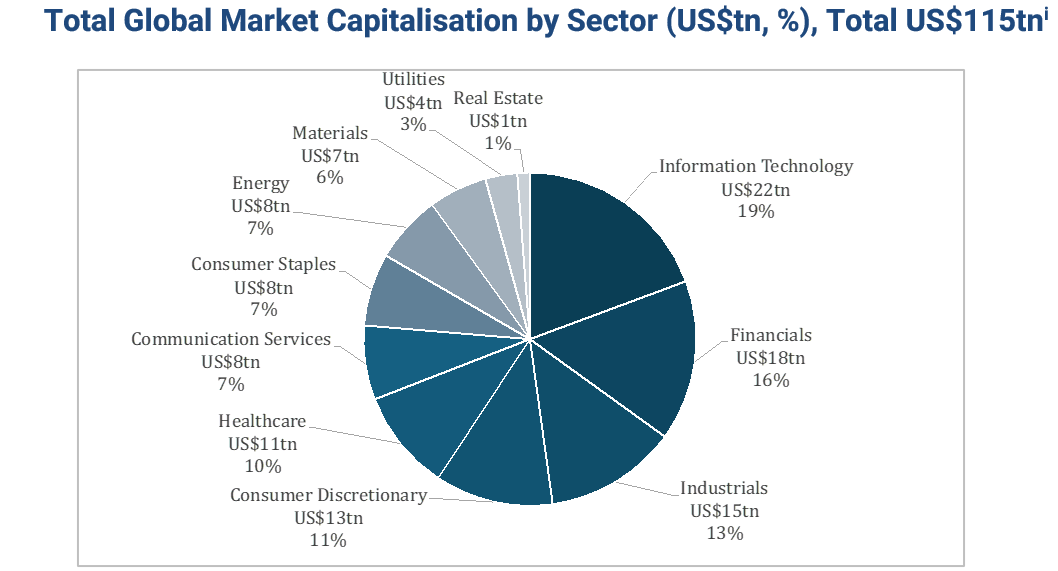
This is particularly the case for the two most valuable sectors, IT and financials, given the universal enabling roles that technology and capital play across time and in all other sectors. While the industrial sector’s share of global corporate value has remained largely static for the past 40 years, IT and finance both have more than doubled their share over the same period, largely at the expense of the energy sector. Moreover, both IT and financials are likely to continue to grow their share of global value, while the energy sector is likely to face further restructuring as the world transitions away from the fossil fuels produced by yesterday’s global oil majors.
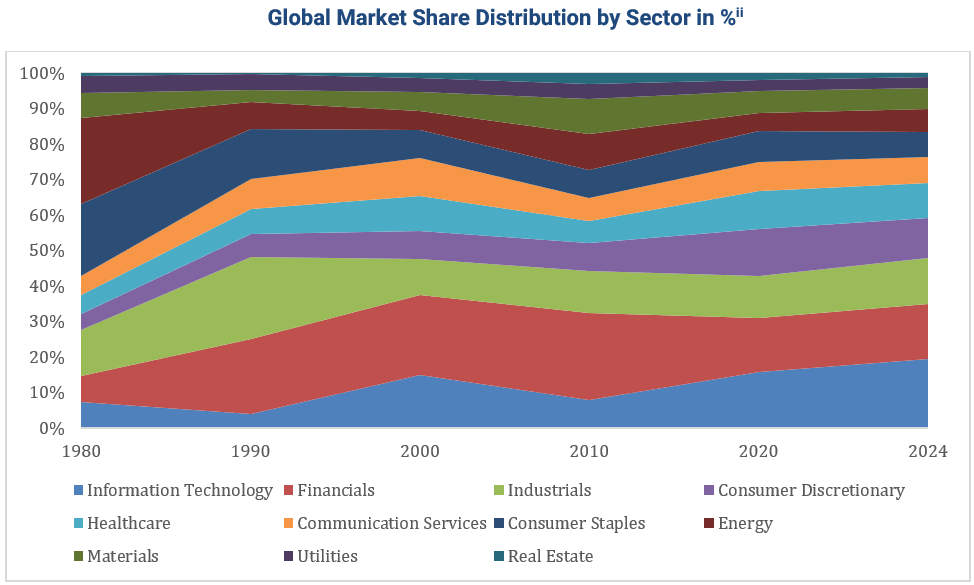
Technology is a, if not the, key catalyst for the civilizational shift underway. Today, we are in the middle of the Fourth Industrial Revolution which is increasingly Given the shift from the industrial to the information era, global scale and value in technology is a critical indicator of which countries are players, and given the need to finance the future, scale in financials is also key blurring the boundaries between industries as IT has become more and more embedded across all industry sectors, using technologies like mobile, the internet of things, artificial intelligence, and data analytics, robotics, autonomous vehicles, 3-D printing, nanotechnology, biotechnology, materials science, and energy storage. As a result, this transition has been expanding the definition of what is commonly understood as the IT sector, encompassing for example companies competing in non-tech sectors with business models that are wholly reliant on IT, with E- commerce and fintech being two of the most notable examples. iii
Capital, and the finance industry that allocates it, plays a similarly important catalytic role. Capital is needed to fuel innovation, drive economic growth, and enable the development of new technologies and infrastructure, funding the global transitions underway in energy, digital technology, and sustainability, as well as being a critical component of geopolitical power.
Implications for India: While India’s demographic dividend and large population are strong near- to medium-term drivers of growth, sustaining long-term growth will depend on building strategic positions in the key industries that are shaping the future.
2. India Lacks Global Corporate Leaders – Across All Sectors
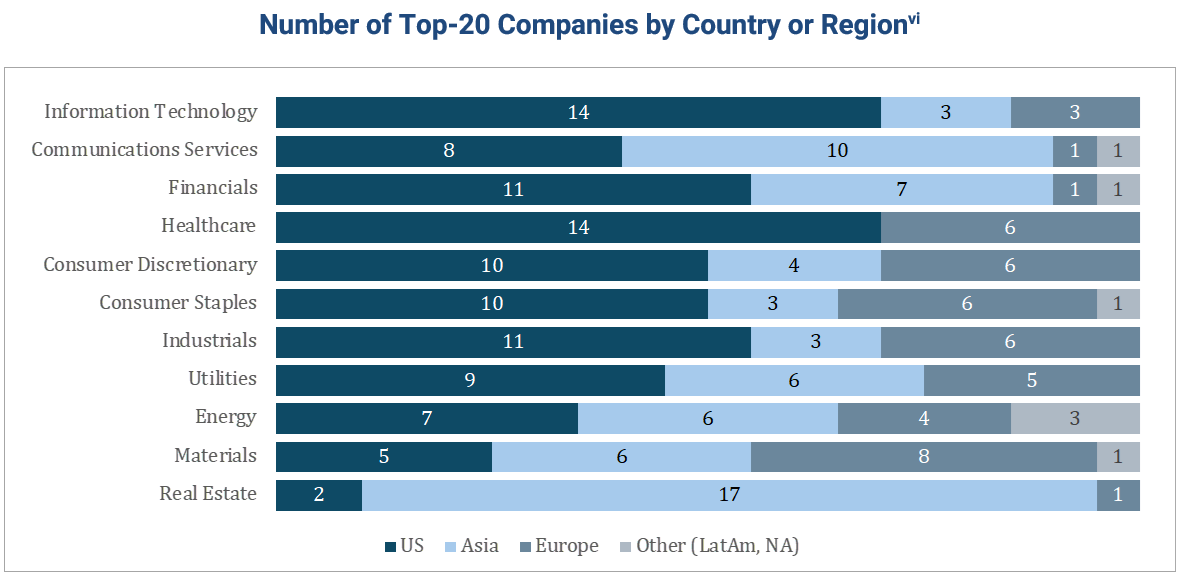
Looking at the list of the 20 most valuable companies by market cap across all 11 major industry sectors a few things stand out clearly. First is the continued dominance of American companies practically across all sectors. Leaving aside real estate, which represents less than 0.5% of global market capitalization, there are 96 American companies, 19 Chinese companies, and only six Indian companies in this group of 200 global corporate leaders.
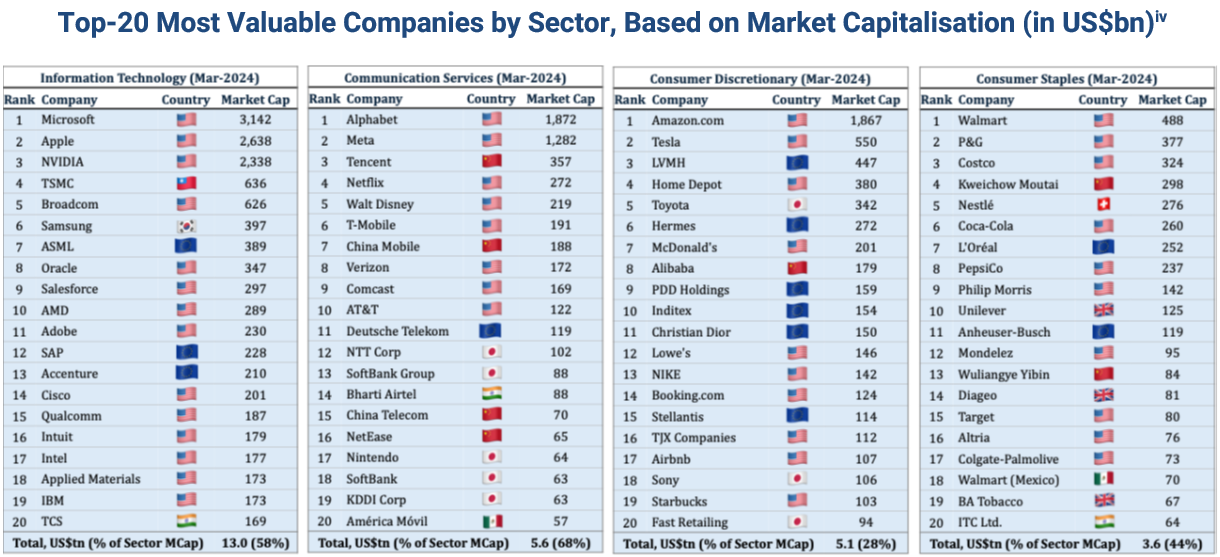
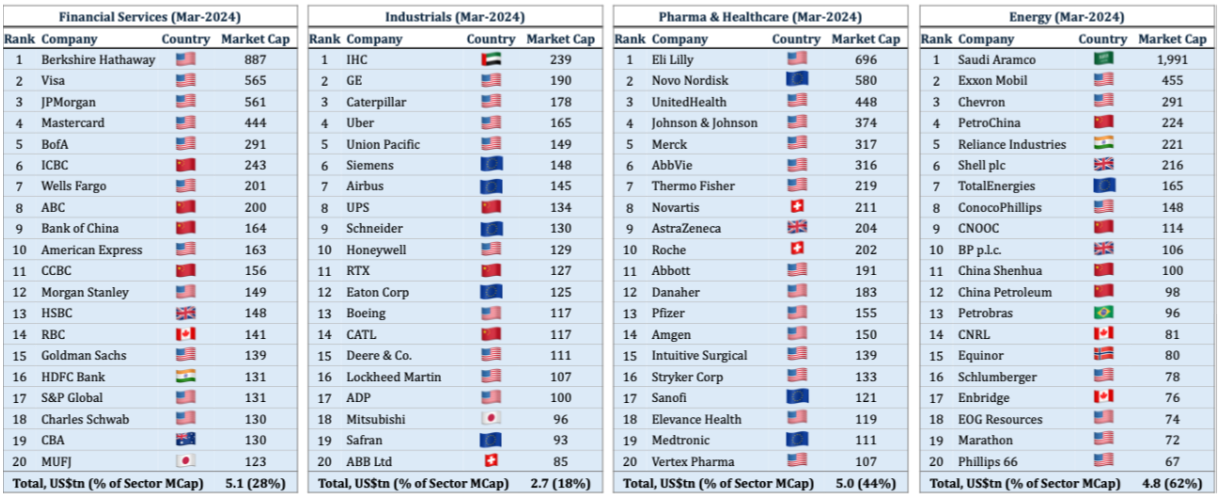
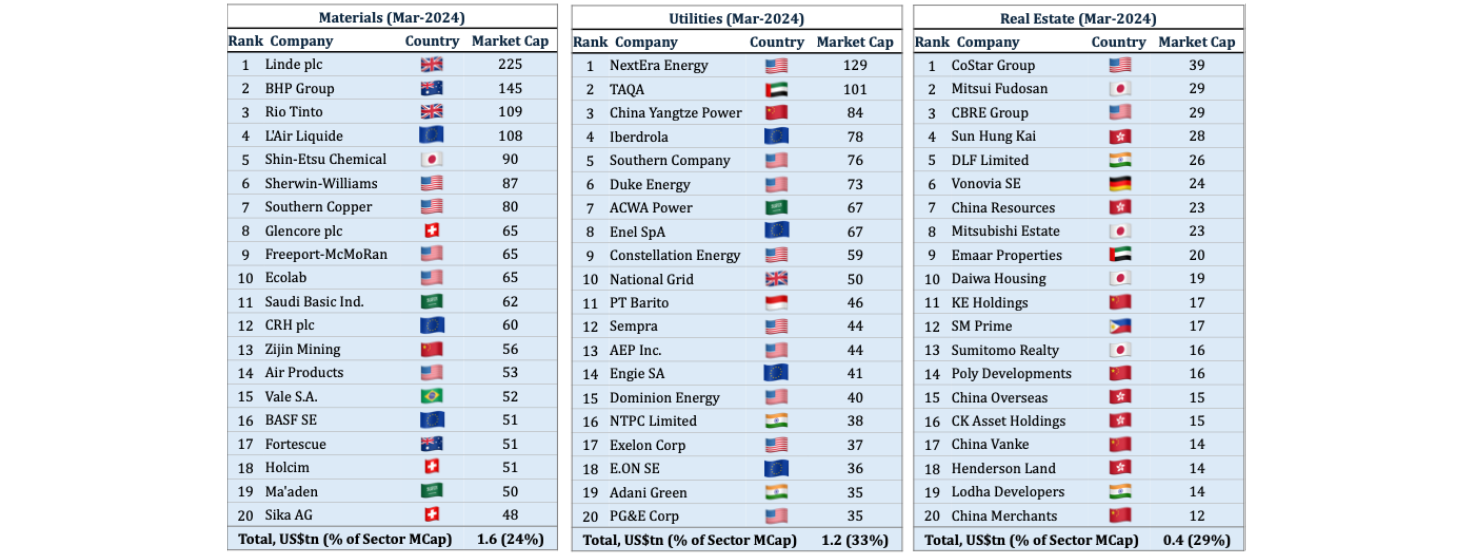
While India’s six companies in the top 200 (or eight companies in 220, if the largest global real estate companies are included) roughly maps to its c.3.5% share of global GDP,v the data clearly indicates that corporate value generally is not tied to national economic output, given it measures many other factors such as future potential value and risk. As a result, while America generates c.25% of global output, it is home to nearly half of global corporate leaders. by value China generates nearly 17% of output and yet has fewer than 10% of global leaders. Importantly, America has among the strongest positions in tech and financial services, home to 14 and 11 of the 20 most valuable companies in each sector. India’s one company on each list is tiny in comparison.
While American companies’ initial success will likely have depended on the existence of a large domestic economies and captive markets for them to test products, refine propositions and build scale, their continued dominance has clearly decoupled from purely domestic economic factors. In fact, nearly 40% of the revenues of the constituents of the S&P500 are generated from international sales, indicating that for most industries, global leaders are in fact global companies.vii
Moreover, the vast majority of the very largest US companies are global, with notable exceptions in infrastructure sectors like communications and utilities. Chinese companies, whether in tech or banking or consumer products, are overwhelmingly focused on domestic markets, with product and service offerings geared to Chinese customers. Most US companies on the other hand have global offerings, potentially tailored to a wide range of markets.
Implications for India: The country’s large domestic market will be critical for companies to build scale, but creating global leaders will require a global growth strategy for most sectors based on sustainable competitive advantages.
3. US Corporate Leadership has Strengthened in the Face of its Relative Economic Share Decline
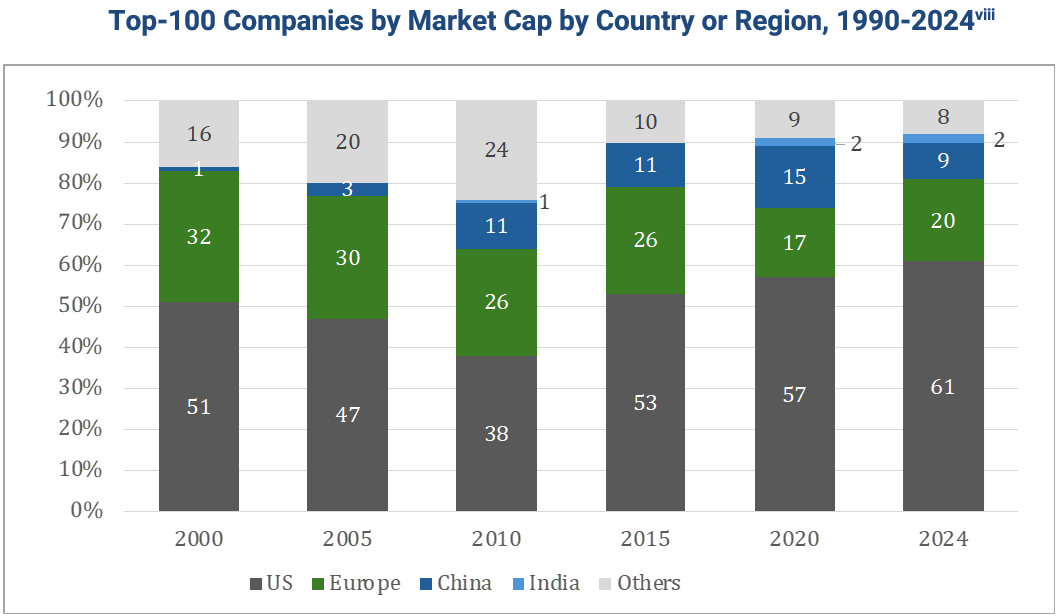
Throughout the 20th century, American companies made the country an economic powerhouse and the source of a majority of global market value. Over the past generation, as its share of global GDP has declined, America has not only defended but actually increased is global corporate leadership (as measured by the top 100 global companies since 2000). While US power generally was negatively impacted by a number of events between 2000-2010, including 9/11, the Dotcom Bubble and the Global Financial Crisis, America reasserted its corporate leadership from 2010 onward, largely by leading the rapid growth of the technology sector relative to the global economy.
China’s companies have also rapidly risen since 2000, when China joined the World Trade Organization, largely at the expense of European countries, while India, barely registers, represented by only two companies in the list of the 100 largest companies by market cap overall (independent of industry sectors despite its rapid growth. Similarly, other countries and regions (including Japan, Russia, Latin America, Southeast Asia) which accounted for nearly a quarter of the top-100 in 2010, are increasingly taking a back seat to the big four power blocs with only a handful of national champions representing them in the top-100.
Some of this leadership relates to US equity markets, rather than the underlying companies. US stocks on average trade at a premium to nearly every other market, ranging from c.50% over Japan’s or the UKs to over 160% in the case of China.ix And American management teams on average tend to place a greater weight on earnings growth vs other key performance indicators, potentially linked to the widespread use of stock-based compensation in the US. However, markets are meant to reflect value in terms of expected risk adjusted returns, and capital markets today expect American corporations to deliver superior performance in this regard. Moreover, America and American companies have long been a magnet for attracting foreign capital from around the world.
Much of America’s long-term corporate dominance however relates to its diversified economy and its system of enterprise. Despite technology and financial services having driven much of the growth in global value over the past 20+ years, (see below) America’s corporate dominance does not come only from having great technology and financial services companies. It comes from having a system of enterprise that can create leaders across a wide range of sectors as value shifts between them. This system is built on a broader US ecosystem of business-friendly regulations and policy regimes, the culture of entrepreneurship, and America’s ability to attract the best global talent play a more critical role in their continued success.
To illustrate how the system of enterprise transcends industries, in the 1980s when the energy and consumer staples sectors captured the greatest share of global value, the US had companies like Exxon, Chevron and Mobil, as well as P&G, Philip Morris and Coca Cola. When value shifted to the industrials and financial services in the 1990s, major US corporations like GE and Boeing, as ll as American Express and JP Morgan emerged as global leaders in these industries. And American companies of course have led both the initial internet boom in the late 1990s and the broader tech one since 2010, too. While this system of enterprise and its parenting in a vibrant and dynamic culture that values democratic and scientific principles and openness might well be eroding in its deeply divided civil conflict between its two political parties – across a broad range of issues from migration, basic freedoms, the nature of its democracy and the energy transition and sustainability, racial identity and prejudice, the application of laws without prejudice – it has not translated into impacts on corporate valuations.
Implications: India’s ability not just to create but to sustain global corporate leaders over time requires a culture of entrepreneurship and ecosystem capable of nurturing companies across a wide range of sectors as value shifts between them.
Conclusion: Building Future Global Champions
The rise of India’s equity markets over the next decade or more is a foregone conclusion. Over the coming decades, India is projected to see the biggest increase in total equity market value, with its share of global equity market cap rising from around 2.5-3% in 2022 to 8% in 2050, and 12% in 2075.xThis development is largely inevitable and tied to the country’s (and the world’s) long term macro-economic growth projections. However, whether this is through pricing (by placing a high value on a small number of businesses) or value (by creating a system of enterprise that allows global giants to emerge) will determine the quality of India’s geoeconomic and geopolitical position, given the intertwined nature of the two, over time.
What is not inevitable is whether the companies driving this market cap rise will be domestic or global leaders. Much of India’s economic growth to date has been delivered by companies that can be called ‘national champions’. Historically, these have mainly consisted of state-owned enterprises with monopolistic or oligopolistic power, or family-controlled multi-sector conglomerates, whose success has often been closely tied to government patronage. While these groups have certainly delivered growth, they have also led to regulatory capture which for much of India’s history has stifled innovation and reduced competition in key industries.xiAs India’s economic and political power expands and becomes increasingly global, it is not clear whether many of these national champions can evolve into global leaders.
India’s ability to build global corporate leaders commensurate with its growing geopolitical and economic ambition and as a critical bulwark supporting its position, will depend on the country’s leveraging a number of key factors, including:
-
Demographics – Using India’s Consumer Base to Build Scale. India’s 1.4 billion population represents the world’s largest potential consumer market. While still tiny in per capita terms, it is set to become the world’s third largest by 2027 as the number of middle- to high-income households rise.xii Companies that can establish strong domestic positions will grow rapidly with the market, providing the scale required for international expansion.
-
Decoupling – Exploiting China’s Decoupling from the West to Go International.The conscious rewiring of global supply chains away from China is an opportunity for India’s corporations to go global, leveraging the trends of friend-shoring and near-shoring to supply an increasingly wide range of for a wide range of materials and manufactured and industrial goods to international customers.
-
Development – Executing a Macro-economic Strategy Addressing Growth and Risk. While mass financial inclusion has provided a strong platform for development, and this crosses all religious and communal lines, India’s macro-economic cost structure remains fragile given its dependency on energy imports and its inflation, interest rates and sovereign rating relative to the major economies. Also, India’s strong headline economic growth and geopolitical positioning has not overcome significant underlying structural complexity, including an outsized role for government investment, increasing income inequality, high youth unemployment, a weak manufacturing sector and rising social-communal-religious unease, make India a highly challenging market for the vast majority of business operating locally, and in turn the international investing community.
-
Digital Revolution - Leveraging Digital Infrastructure Across Industries. IV.India’s increasingly sophisticated digital infrastructure including features like biometric digital IDs (Aadhaar) and instant real-time payments (Unified Payments Interface) provide an opportunity to digitize and transform key industries. For example, India is already the world’s third largest fintech market, despite having only the 15th largest banking sector globally.
Decarbonization – Leapfrogging Industrial Era Industries with Sustainable Innovation.Lacking a scaled oil and gas-dependent industrial base, India can leapfrog other industrialised nations in developing the post-carbon industries that will deliver the energy, materials, products and services of the future, without the cost of transitioning away from old industrial infrastructure.
India is poised to play a defining role in shaping the future of the global economy in 2024 and beyond. However, the country’s long-term success ultimately depends on creating and operating a system of enterprise that is open, competitive, dynamic, sustainable, inclusive and fair. Achieving this is key to a set of global corporate leaders from the country worthy of its geopolitical and economic ambitions are sure to emerge. And this will provide important lessons for other emerging markets across the Global South.
The Leader: Endnotes
- Source: As of March 2024, Source: CapitalIQ
- Source: CapitalIQ
- Source: 2023 Technology as a Force for Good Report
- Source: CapitalIQ data as of 26 March 2024
- Source: World Bank
- Source: Morningstar
- Source; CapitalIQ
- Source: https://worldperatio.com
- Source: Goldman Sachs
- Sources; Organized Crime and Corruption Reporting Project, “Commander s., Estrin, S. “The Connections World The Future of Asian Capitalism”, 2022 Cambridge University Press
- Source: BMI


