
This past month witnessed the largest democratic exercise in human history, with 645 million Indians casting their votes in the country’s general election, out of nearly one billion registered voters. The end result was a historic third consecutive term for the Bhartiya Janata Party (BJP) led National Democratic Alliance (NDA), with Prime Minister Narendra Modi becoming the first Indian PM to win a third consecutive term since Jawarhalal Nehru in 1962. The BJP won more than twice as many seats as the next largest party, its rival the Indian National Congress (INC), signalling the BJP’s continued status as the dominant national party under Mr. Modi’s leadership.
While the NDA won a relatively comfortable majority with 293 seats, the BJP itself lost the single party majority which it has held through two elections since 2014, with the party going from 303 seats to 240 seats in the lower house of parliament, 32 seats short of an absolute majority. This means that the BJP will now depend further on its coalition partners to govern. Meanwhile, the opposition INC-led Indian National Developmental Inclusive Alliance (INDIA) made significant gains by consolidating the anti-BJP vote with 28 alliance partners. The INC nearly doubled its tally to 99 seats, and the alliance as a whole won 234 seats in parliament, strengthening its voice as the parliamentary opposition, but leaving it short of a number that would allow it to try and form the government, which with such a large alliance would have posed enormous challenges in governing of course.
The electorate appears to have rewarded the BJP with a third term for its reforms, infrastructure buildout and economic delivery, recognising PM Modi as the best placed to lead the country and deliver on its developmental aspirations. At the same time, by strengthening a consolidated opposition, it has put in place strong institutional checks against the BJP by denying it the super-majority that it had sought in order to make radical changes. These results suggest that India’s democracy continues to be both effective and robust.
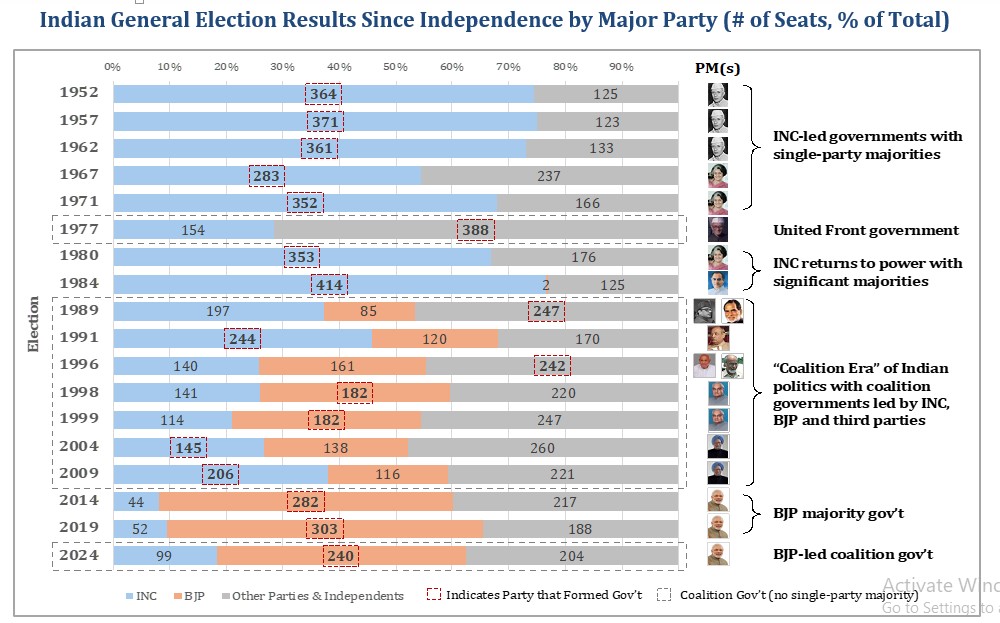
The results also indicate a return to the ‘Coalition Era’ of politics which had been the norm in India for a generation, from 1989 through Mr. Modi’s rise in 2014. During this period, successive coalition governments, led by both the BJP, the INC and third parties have pursued an agenda of reforms to liberalise the Indian economy, and helped it achieve an average real GDP growth rate of 6% over the last 35 years from 1989 to 2024 (vs. 4% over the preceding 35 years from 1954-1989)1. Coalition politics in general have focused on consensus-building and reforms over more ideological agendas which alienate allies. The election results however signal political stability given that the BJP has proven its ability to manage a coalition in its previous term (previous coalitions indicate stability comes with c.180-200 or more seats in parliament, which the BJP has). This political stability will in turn help ensure policy continuity that should keep India’s on its current macroeconomic trajectory.
This election comes at a pivotal time for both India and the world. Globally, we are in the midst of multiple significant transitions including in energy, technology and geopolitics. Two ongoing major regional conflicts threaten to spill into global ones. India has the potential to be a critical global player in the coming years both economically – it is the fastest growing major economy currently and has reached a scale of US$4 trillion2 – and geopolitically. How well the new government capitalises on this opportunity will likely determine its fate in the next election.
This month’s Sign looks at the results of India’s general election in their historical context, and evaluates the potential implications both in terms of policy continuity and political stability in the near-to-medium term, and in terms of India’s longer-term economic trajectory to become one of the largest economies in the world.
The Results
Led by PM Narendra Modi’s BJP, the NDA won a historic third term in India’s 2024 general election, winning 293 parliamentary seats for a comfortable governing majority. While PM Modi became the first Indian Prime Minister to win a third consecutive term in over 60 years, the win was tempered by a significant erosion of seats for the BJP, and stronger than expected performance by the INC-led opposition alliance, which won 234 seats, a 99 seat gain over the previous election. The election broke the record for the most expensive electoral event in history with total estimated spending of c.US$16.3 billion3 , of which c.US$1.5 billion was financed by anonymous ‘electoral bonds’4 , which were banned by India’s Supreme Court in February 2024.

Though PM Modi’s re-election was widely predicted and expected, the results nevertheless surprised most observers (and market participants), given that polling had almost unanimously forecast a landslide victory for the NDA, with pre-election polls predicting that the ruling alliance would further build on its majority and win c.375 seats6, and exit polls (taken at the time of voting) predicting the ruling alliance at least maintaining its current tally of c.350 seats7, with the BJP preserving its single party parliamentary majority.
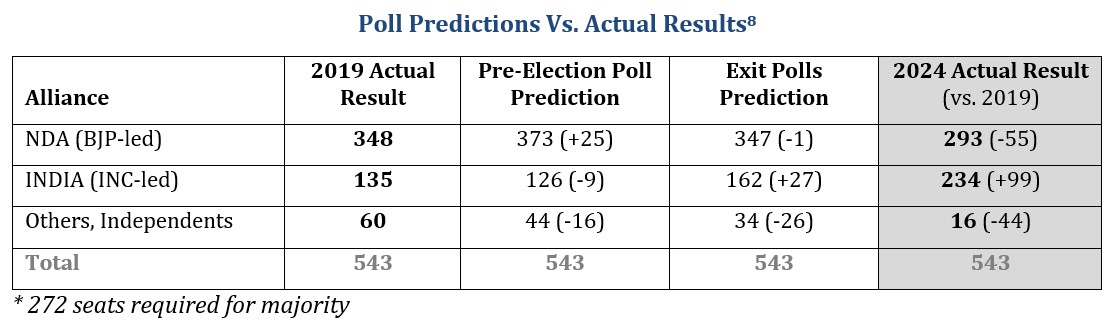
However, when the actual votes were tabulated, the BJP ended up losing 63 seats and its single party majority, and unlike in 2014 and 2019, it is now dependent on its coalition allies to preserve its majority. The INC and several large regional parties allied with it made significant gains, in particular in the large states of Uttar Pradesh and Maharashtra, where the BJP had dominated in previous two elections (see 2024 vs. 2019 electoral map below).

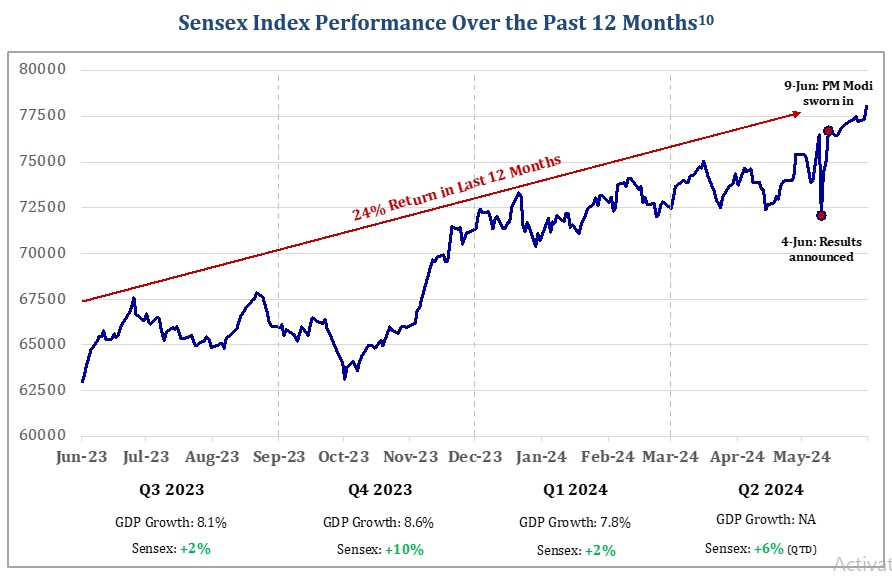
On the day of the announcement of the results (4th June), equity markets reacted sharply to the worse-than-expected performance by the BJP, with the benchmark Sensex declining by 6% and erasing the gains it had made since the beginning of the year. However, over the subsequent days, as it became clear that Mr. Modi would be able to form a stable coalition government and the new government was sworn in, these losses were quickly reversed and by the end of the week (7th June), markets had recovered to their pre-election levels (and have gained an additional 2% since then).
Overall, India’s equity markets have been among the best performing globally, returning 8% over the past six months, and 24% over the past 12 months, on the back of strong economic performance and earnings growth, combined with expectations of policy continuity and political stability under PM Modi, which now appears to be fully priced into the markets (see chart below).
Historical Context
Understanding both the near- and long-term implications of these results requires examining them in their historical context across three dimensions: India’s changing demographics, the changing alignment of its political parties, and its economic transformation.
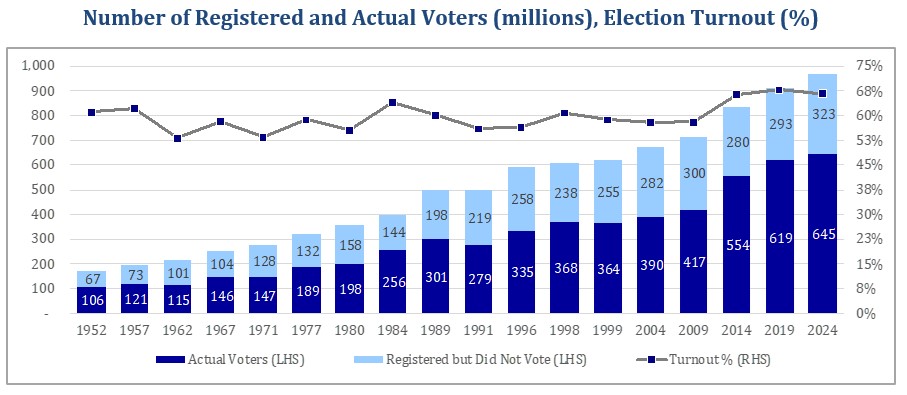
Firstly, given India’s young and growing demographic profile, the size of its electorate has grown approximately five-fold since independence from c.200 million registered voters in the first general election in 1952 to nearly one billion registered voters currently (see chart below). Over the last 35 years alone, the size of the electorate has doubled. As a result, new voters have consistently had a strong influence on election outcomes, and contributed to increased anti-incumbency as the country’s politics and economy have become more mature.
Secondly, the last 35 years of India’s politics stand in sharp stark contrast to its first four decades as an independent country, where the INC had a monopoly as the dominant national party and was able to govern nearly uninterrupted (other than a brief period of three years from 1977-79) with clear parliamentary majorities. This gave way in 1989 to the “Coalition Era” of Indian politics with the BJP rising as a competing national party, and several large regional parties (some of which were breakaways from the INC) establishing pockets of political support. In this context, the last decade of a single-party majority for the BJP might be an aberration, and the latest election’s results perhaps signal a return to the Coalition Era.
In the initial decade of the Coalition Era, Indian politics were unstable, with short-lived coalition governments led by third party leaders supported from the outside by either the INC or BJP; and the INC and BJP governments were under constant threat of collapse from the withdrawal of key allies11. However, this changed after 1999, with both the BJP and INC learning how to better manage coalition allies (which seemed to be supported by the electorate supporting political stability and punishing opportunistic parties that collapsed the government), leading to stable INC- or BJP-led coalition governments that lasted their full five year terms, even when there was some degree of churn in their allies.
Thirdly, the last 35 years since the start of the Coalition Era have seen India’s economy rapidly liberalise and grow, with successive governments (under both the BJP and INC) implementing a range of structural reforms that have helped accelerate real GDP growth to over 6% during this period vs. c.4% in the preceding 35 years. India’s economy has scaled significantly during this period, growing 66x in local currency terms and 13x in US$ terms, from c.US$300 billion in 1989 to c.US$4 trillion in 2024)12.
The notion that coalition governments are prone to political compulsions that prevent them from reforming the economy is not borne out by the long list of structural and market-based reforms implemented by various coalition governments (see chart below).
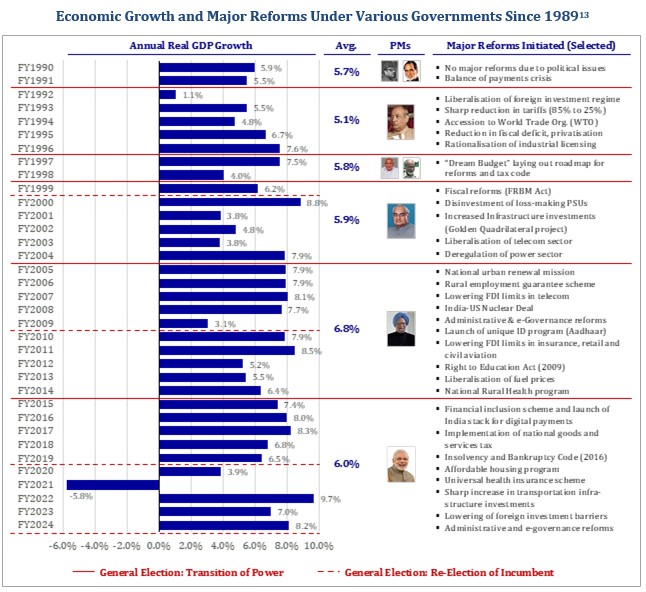
Theoretically, coalition politics puts significant pressure on ruling parties to perform and deliver on their promises and the electorate’s expectations, as a result of which ruling parties have chosen to undertake major reforms even when they are politically difficult. Coalition politics also help ensure that structural reforms are implemented based on democratic consensus rather than by fiat, as a result of which the reforms which have been enacted have been enduring and not been reversed by successor governments.
Inevitably, coalitions involve trade-offs making critical reforms very difficult to implement; in the years leading up to Mr. Modi’s election in 2014, foreign investors started to doubt India’s ability to introduce a unified national goods and services tax, build infrastructure the way China had shown it could, deliver an efficient court system for insolvency, and the consensus was that India’s coalition politics were ineffective relative to China’s autocracy. There was also a growing perception that the incumbents had become complacent and ineffective, and the retrospective tax the INC coalition introduced had destroyed the rupee and led to an exodus of foreign capital. The Indian public seemed to agree that the coalition was not working in 2014, given the domestic issues of the day too – high inflation, lack of jobs, economic performance, corruption, security and terrorism, identity politics, and basic infrastructure in the form of roads, electricity and water – and voted against the INC-led coalition and its leaders in favour of a strong single leader in Mr. Modi, providing the BJP a majority, which it further built on in 2019. Mr. Modi went on to implement the difficult reforms that foreign investors had doubted could be implemented. This is not to say some of the reforms by the INC before him such as allowing FDI in retail, insurance and aviation sectors, and fuel price deregulation were not difficult too, but the public mood had shifted away from coalitions. This raises the question of whether the 2024 election was a vote for coalitions, a protest message to PM Modi and the BJP, or a failure by the BJP to make the right coalition deals in the lead up to the election. What is clear from the results is that the public were not ready for the INC to govern, and it also seems unlikely that the public actually wanted a fractious coalition of 28 parties to run the country.
Key Implications of the Election and an Agenda for the New Government
Given this election result comes on the back of a year that saw India lead the world from the position of heading the G20, land a space craft on the south pole of the moon, and cross half a billion bank accounts in its PMJDY mass financial inclusion scheme14, it bears analysis in terms of what it means for governing India.
In this context, the results of the 2024 election have a number of implications that are critical for both government leaders and market participants to understand, in particular:
-
India’s Democracy Remains Resilient and Robust. Recent reports of India’s “democratic backsliding” and decline – India’s rank on the Liberal Democracy Index has fallen from 70th in 2016 to 104th in 202315 – appear to have been premature. The 2024 election saw strong voter turnout of 67%, the second highest of any general election in India’s independent history (1% lower than 2019 election). And despite the sheer size and complexity of India’s electorate, the election was executed seamlessly, using digital voting and no major credible reports of fraud or malfeasance. The electorate rewarded the incumbent government’s performance on reforms and economic growth, while ensuring that even powerful and successful leaders are held accountable for continued delivery. In a world of rising national populism and increasing autocracy, India has provided a powerful example to both developed and developing countries that democracy can indeed work.
-
Political Stability and Policy Continuity Expected. The initial market reaction on the day the results were announced suggests that market participants were concerned over political stability and the continuity of the BJP’s policy reforms program, given the BJP’s lost its single party majority. However, the rapid reversion to pre-election levels (and beyond) suggests that the market has understood that, even without an outright majority, the BJP has a comfortable plurality of seats to ensure that its coalition allies cannot hold it hostage. As the previous section illustrates, both the BJP and INC have been able to effectively manage stable coalition governments to their full five year term, implementing major legislative reforms, as long as they have c.180-200 seats. Policy priorities, as they relate to economic and market reforms, are also unlikely to change significantly, given that the BJP will be keen to ensure that it delivers on its economic promises, and ensures that India stays on a high-growth trajectory and will likely focus on ensuring the benefits of growth are more widespread.
-
The Limits of Divisive Politics. The key issue with single party majorities is that they encourage the ruling party to move from a practical economic and reforms orientation towards agendas pushed by often vocal minorities within its base, which can divide the populace and challenge social harmony and stability. This is of particular concern to India given the scale of its religious, ethnic and linguistic diversity. In the first four decades of the INC’s single party majorities, this took the form of an ideological prioritisation of socialist policies that inhibited growth and identity-based politics that divided the populace along religious lines, eventually leading to the BJP’s ascendance in the 1980s. In the last decade, this manifested in an ideological agenda, supported by parts of the BJP, that seeks to define India as a Hindu nation, with certain policies and political rhetoric that alienated the country’s minorities, leading to the consolidation of their vote and the BJP’s worse than expected performance in the election. In contrast, coalition governments tend to revert to focusing on core pocketbook issues, seeing broad-based economic development as the surest path to improving their political positions.
-
Consensus-Based vs. Bare Knuckle Politics Ahead? One view is that over time, the compulsions of managing a coalition and a strengthened opposition will likely lead to a more consensus-based political approach where both allies and the opposition need to at times be accommodated rather than vilified when they disagree. In this view, absolute majorities tend to encourage ruling parties towards disregarding the opposition (and sometimes their own allies), trying to capture or co-opt key institutions and the media, and governing by fiat and fear, rather than by making deals and building an enduring political consensus amongst stakeholders. And this would mean that coalition politics makes this far more difficult, as the ruling party needs to constantly ensure that it has sufficient outside support to govern effectively and implement the most critical elements of its agenda. The alternative view is that bare-knuckle politics is not over, and the main task ahead for the BJP is to swing more politicians to their coalition and run by fiat. The months ahead will be informative.
-
Home Economics Matter, and the Public Keeps Raising the Bar. Despite the recognition of PM Modi’s leadership on the world stage, it is evident that the public cares most about domestic issues, and delivery creates greater expectations. Though India's economic growth remained robust with 7.8% GDP growth in Q1 2024 (faster than consensus estimates), this growth was not sufficiently felt by the public at large. While the top 10% of the country’s wealthiest citizens continue to accumulate wealth at a materially higher rate than the rest of the country16, employment generation has been weak with India’s rural unemployment rate rising to c.8% and youth unemployment (ages 20-24) increasing to 44% in Q1 202417. This uneven growth is further exacerbated by growing regional imbalances, with southern and western India growing 12% faster than northern and eastern India18, and weak manufacturing performance, given the general slowdown in world trade and India’s lack of competitiveness in labour-intensive products19.
-
The Next Election Will be a Harder Fight. While the BJP likely has a comfortable plurality of seats to ensure a stable coalition government that lasts its full five year term, if it loses another c.50 seats in the next election, it may well face challenges in staying in power. On the other side, the INC, after being nearly wiped out in the 2014 and 2019 elections, may well believe it can potentially leverage its regional allies to form its own coalition government. Whether this is true or not, whether it is feasible to run the government of India effectively with such a large number of coalition partners, the equation has changed for the current government and the opposition feels revived. This means that there will be significantly increased pressure on both the ruling coalition and the opposition to be seen to be delivering on the aspirations and expectations of their constituents. The easiest way to do this will be to focus on delivering on key development priorities (see inset below).
The Agenda for the New BJP-Led NDA Government: Five Key Development Priorities
The new government has its work cut out for it given the electorate has given it a mandate, with a reduced majority to work with. In this context, the surest path to victory in the next election will be to focus on key development priorities that help India achieve its economic potential. There are five key areas where the government can focus on to do this:
-
Leveraging India Stack for Financial Inclusion and Beyond. PM Modi’s flagship financial inclusion scheme and the implementation of the “India Stack” of digital public goods has brought over c.525 million Indians into the banking system20 and made mobile-based digital payments ubiquitous. But India still needs to deliver formal affordable credit and other financial products to the vast bulk of its population, and needs to mobilise domestic financial savings in order to invest in its rapid growth. The India Stack offers a path for rapid disruptive expansion of financial inclusion over the coming years and the financialisation of domestic savings, while also providing a platform and model for improving the quality and delivery of other critical services including health and education. The government is already thinking in this direction, and more interventions to drive further augmentation to the Stack, and an entrepreneurial ecosystem that builds real-world applications on top of it can help drive productivity and growth in the near-term while addressing India’s long-term structural challenges too in a more cost effective manner.21
-
Building Innovation and Leadership in AI. Rapid advances in AI stand to disrupt virtually every aspect of our lives over the next decade, with up to 25% of current jobs globally at risk of AI-driven automation22 . Countries and companies are already competing for leadership across various aspects of the field, and will continue to do so over the next decade. Thus far, India has built a base as a low-cost outsourcing center for IT services, but has yet to deliver real innovation and products which would allow its tech companies to break into the ranks of global industry leaders. Doing so will require mobilising investment in R&D, creating an open and competitive system of enterprise that rewards innovation, and financing the entrepreneurs and companies doing so; while creating robust governance structures to guard against both current and future risks of AI.23
-
Driving India’s Energy Transition. With the impacts of climate change increasingly becoming evident to all, the world is in the midst of a global energy transition to clean sources of energy that will need to accelerate in the coming years. India, already facing record heat waves and temperatures, will continue to struggle to balance its growing energy needs with the costs of climate change it is likely to endure, necessitating radical actions to accelerate the move away from fossil fuels. In the coming years, India will need to prioritise securing the energy to fund its growth, while simultaneously investing in climate adaption as well as mitigation through decarbonising its energy mix, looking to electrify transport and industrial activities, and moving to more energy efficient production. This will require innovative and significant government policy interventions, including subsidies and other incentives where required to shift consumption patterns and behaviours.
-
Educating, Skilling and Employing India’s Youth. India is facing a significant youth unemployment problem with an estimated 44% of 20-24 year olds unemployed, and its main generator of white collar youth employment, the IT outsourcing sector, facing a slowdown due to global macro changes and innovations in AI. These youths are also likely the swing votes that could determine the outcome of the next election. Driving employment generation at scale therefore needs to be a critical priority, not only for India to realise its economic development aspirations and fully leverage its demographic advantage over the other major global economic power blocs, but also from a political perspective. The New Education Policy introduced by the government in 2020 is a step in that direction, however, now it needs to be implemented systematically state by state in order to radically expand access to an affordable and quality education by leveraging technology, and for training India’s youth with the skills needed for the jobs of the future.
-
Providing Access to Affordable and Quality Healthcare. India’s healthcare sector has been held back by a host of structural issues and the inherent challenges of delivering quality and affordable healthcare to 1.4 billion people, the majority of whom are still living in relative poverty. While India has become a low-cost hub for generic pharmaceuticals and seen significant recent investments in building up hospital capacity, a more holistic approach that fully leverages technology is needed to provide a basic level of healthcare to every Indian. The government has taken some initial steps in this direction through its universal health insurance scheme for example, but the core issue remains the lack of delivery capacity (both in terms of physical and human capital). Policies that help drive rapid capacity creation in high-quality and affordable healthcare, including by leveraging technology, will directly impact the electorate and likely drive political dividends.
Conclusions: A Focus on Action and Execution
As previous Sign of the Times have explained, the world is in the midst of several major simultaneous transitions24. Climate change seems to be reaching a tipping point with increased catastrophic extreme weather events which requires accelerating the transition to clean energy sources. Rapid advances in AI stand to potentially disrupt various aspects of life, just as digitisation did over the last two decades. And geopolitically, the world is moving to a multi-polar world order with four clear power blocs in the US, China, the EU and India cooperating and competing to lead the world25.
India is in a unique position given its scale and demographics to become one of the biggest drivers of the world economy in the coming years and a top-3 upper middle-income economy with a GDP of US$7-8 trillion by 2030. If achieved, this would put the country on track to be a high-income country by the middle of the century, and if we can project far enough, the largest economy before the end of this century26. By all accounts, this should be India’s Century, economically and geopolitically. However, realising this promise requires leadership that delivers on India’s potential while simultaneously managing the risks that it faces.
The recently concluded general election has therefore come at an important inflection point for both India and the world. And it has delivered an outcome that will likely keep India on that track by delivering policy continuity and political stability, but with increased accountability. The electorate has rewarded PM Modi for leading the country through a series of reforms that appear to have unlocked significant economic potential and growth. But at the same time, in denying the BJP a single party majority and strengthening the opposition, it has made the government more accountable and provided it with a clear mandate for pragmatic economic reforms and policies, while discouraging the pursuit of a more ideological agenda that threatens long-term social stability.
One of the lessons of the recent election is that a more inclusive approach to growth and development is needed, not one based on handouts, but one based on creating a genuine system of enterprise that drives entrepreneurship, investment and ultimately mass inclusion across a range of sectors (energy, finance, healthcare, education and technology). This is critical for India to achieve its full economic potential, and if it is broad based as measures to drive the UN SDGs, it will be multi-faceted in its impact on the public and the planet. Politically, this is a winning proposition too: only when the fruits of reforms, growth, and increased international influence are widely enjoyed and felt by the mass public does it to pay political dividends (as the BJP learned in its 2004 loss when it ran on an “India Shining” campaign).
This election has shown that India’s population is hungry for development and growth, with its youth’s aspirations driving the country’s economy forward. India’s body politic has re-elected PM Modi to continue the country’s reforms and development agenda, while strengthening the opposition to hold the government accountable to deliver, and rein in its more ideological impulses. As one of the four major global power blocs, and the fastest growing one, with an economy crossing US$4 trillion, India is at a pivotal moment both economically and geopolitically. Delivering inclusive growth over the coming years will allow it to continue to rapidly scale and become a leading global superpower and a model for the Global South. How well the new government executes on this promise will likely decide the outcome on the next election.
The Leader: Endnotes
-
Source: Reserve Bank of India Database
-
Source: IMF World Economic Outlook, April 2024
-
Source: Centre for Media Studies
-
Source: Business Standard
-
Source: Election Commission of India
-
Average of 10 national polls taken between Feb-Apr 2024 (see endnote 6 for sources)
-
Average of 15 exit polls published on 1 June 2024 (see endnote 6 for sources)
-
Sources: ABP News-CVoter, Times Now-ETG, India Today-CVoter, News 18, India TV-CNX, Zee News-Matrize, TV9-People’s Insight-Polstrat, Agni News Services, Dainik Bhaskar, DB Live, India Today-Axis My India, India News-Dynamics, NDTV-Jan Ki Baat, News18-CNBC, News24-Today’s Chanakya, News Nation, Republic TV-Matrize, Republic TV-PMarq
-
Source: NDTV.com
-
Source: CapitalIQ, Ministry of Statistics and Programme Implementation
-
For example, within a year of the 1998 general election, a key regional ally withdrew from the BJP’s coalition triggering a fresh election, and in 2009, the left front parties supporting the INC-led coalition withdrew support triggering a vote of confidence (the BJP and INC, respectively, managed to stay in power in both situations)
-
Sources: Reserve Bank of India, IMF World Economic Outlook Database
-
Fiscal year ending 31st March; FYs attributed to government which was in power for majority of FY
-
Source: pmjdy.gov.in
-
Source: V-Dem 2024
-
Source: World Inequality Lab, Income and Wealth Inequality in India, 1922-2023: The Rise of the Billionaire Raj, March 2024
-
Source: CMIE
-
Source: Ministry of Statistics and Programme Implementation
-
Source: Manufacturing Competitiveness Report, IFC Institute for Competitiveness
-
Source: pmjdy.gov.in
-
For further information, please see Sign Leader from September 2022,Technology as the Enabler of Systemic Financial Revolution
-
Source: Goldman Sachs
-
For further information, please see Sign Leader from December 2023, Artificial Intelligence: From Slave to Master
-
See Sign Leader from April 2024, The End of Yesterday, The Future is Well Underway
-
See Sign Leader from November 2023, The Consequences of Local Conflicts of Global Stability
-
See Sign Leader from September 2023, India’s G20 Presidency Spotlighted the Drivers of Its Growth Engine


