
Donald Trump has reclaimed office as the 47th President of the United States in what is being called one of the most remarkable political comebacks in history. After a tumultuous first term marked by economic, geopolitical, and social upheavals, Trump returns to office with a sharper focus, a ready team, and plans to vigorously pursue his "Make America Great Again" agenda. His second administration has already set a disruptive tone, with sweeping executive orders that revive policies from his first term, including increased tariffs, aggressive border control, a renewed emphasis on fossil fuels, and a rejection of climate-focused agreements. However, Trump has also introduced ambitious new initiatives, such as regaining control of the Panama Canal, buying Greenland, strengthening the military, and launching a mission to Mars, signalling a shift toward a more expansionist global (and interplanetary) set of initiatives.
The second Trump administration’s agenda and actions will unfold amid a world in transition, shaped by long-term climate change, technological innovation, and global demographic shifts. The next four years promise to be pivotal in determining how the world will manage these transitions, and the policies, priorities and actions of the incoming president are likely to play a critical if not deciding role on the world’s trajectory across several global challenges. It promises to be a highly disruptive time for the world, with a Trump presidency, likely even more of a roller-coaster ride.
This month’s Sign of the Times looks at 12 global challenges facing the world, charting both the negative and positive potential paths the world might take and the potential role that America’s president and others might play in this regard.
Trump 2.0 - The Intention to Shake the World
Donald Trump is the 47th president. In what is being hailed as one of the greatest comebacks ever, the former president swept the November 2024 election to reclaim the position as America’s chief executive.
Trump’s first administration was an economic, geopolitical and social roller coaster as America and the world tried to, and often failed to come to grips with the mercurial businessman and media personality turned populist leader. During these first four years trump overthrew countless norms on how to lead and how to govern, while presenting and executing a fundamentally different conception of American leadership in the world, with significant long-term implications for the global order. Much has made of the previous term’s moments that led to endless media coverage of and the creation of memes overs the size of the crowd at the first inauguration, injecting disinfectant to treat covid, saluting one of Kim Jong Un’s generals, staring at a solar eclipse, and more. Of course there were serious matters too, the insurrection and attack on congress, the call for more votes to be found and accusing the opposition of voter fraud, the guilty verdicts on the Trump business for falsifying facts and sexual assault, the withholding of secret government documents, the withdrawal from the Paris Agreement, the war on so many individuals including black athletes, the support for white nationalist ‘very fine people’, and more. However, it would be a mistake to judge this next term on the events of the previous one.
While Donald Trump may well be the same man who left office in 2021, the next four years promise to be very different to his first administration. Trump is entering his second term much more well prepared than the first time, with a well-prepared and experienced team in place and plans to execute on his Make America Great Again agenda. His inaugural speech and a barrage of executive orders signed on his first day in office provide an indication of what the next four years may hold for the world, and it promises to be a shock to the system, sometimes in substance and sometimes in attitude.
Many of the promises made in his speech and in these orders are holdovers from the first administration, promising a degree of continuity in terms of the expected policy priorities. Tariffs promise to be a mainstay of economic and foreign policy, with Trump promising to increase tariffs across the board, from up to 100% on China, 25% on imports from Canada and Mexico, and yet unspecified tariffs on the EU, alongside a plan to impose a “The world now faces the challenge of determining which of his pronouncements, from taking back control of the Panama Canal, annexing Greenland, and bringing ‘peace to the world’ are bluster and which are action items” universal tariff on all imports. Similarly, there is the ongoing focus on border protection and illegal immigration, with Trump signing a national emergency on the US-Mexico border, and the promotion of fossil fuels and domestic manufacturing, with America leaving the Paris Agreement again, ending the Green New Deal and declaring a national energy emergency to “drill, baby, drill.” These priorities and actions are much loved by Trump’s traditional political base, as is the rescinding of a slew of Biden executive orders on diversity, equity, and inclusion. On the foreign relations front, there is the intention this time to force a transfer of Greenland, raise NATO members’ defence spending to 5% of GDP, and withdrawing from the Paris Agreement (again) as well as from the World Health Organization. However, while these priorities may not be novel, Trump’s means and readiness to act on them this time around is, lending significant weight to what some critics have historically dismissed as performative rhetoric.
On the other hand, other pronouncements made on day one of the second Trump Administration were entirely new and point to a potential shift in priorities for the president. Among other things, Trump promised to take back control of the Panama Canal, annex Canada and control Greenland, build ‘the strongest military the world has ever seen’, and to ‘bring peace to the world’. Such actions would be sharp departures from the isolationist vision and policies of the first Trump administration, pointing to an expansionist vision of America and its role in the world, and indeed beyond it, with Trump also promising to plant the stars and stripes on the planet Mars, with an explicit reference of America’s Manifest Destiny.
The world now faces the challenge of determining which of his pronouncements are bluster and which are action items. Views on this range from taking the man who says he was ‘saved by god’ to rescue America at his word, to discounting everything he says on the assumption that Trump prioritises form over substance and will be satisfied with declaring rather than actually achieving victory. A third view sees a hard-nosed businessman using maximalist statements and shock and awe tactics to reach desirable outcomes across a series of more limited goals.
Regardless of where the flurry of initial promises fall, Donald Trump’s second term has already reshaped the geopolitical landscape by the time it has started. An Israel-Gaza ceasefire deal came into effect after 15 months of violence – as demanded by Trump, Russia has escalated its military assault on Ukraine, improving Russia’s starting point in the deal negotiations Trump is calling for, and Canada’s prime minster has resigned following a series of personal attacks and threats of tariffs from the incoming president. This disruptive impact is only likely to grow as the president settles into office.
A Road Map for the Journey Ahead
The second Trump administration, the president’s agenda, and any actions undertaken by his administration over the next four years will unfold against the backdrop of a world in transition. Regardless of the individuals in power, their belief or their policies, the fundamental reality of the world is one of long-term climate change, technological “Trump's presidency has an important bearing on global transitions, in particular on the renewal or end of American power, the speed of the energy transition speed, and whether AI is to be unfettered or managed” change from progressive innovation, and global demographic change, with the global population growing to ten billion people and industrialised economies ageing significantly vis a vis developing ones.
These changes, and the world’s cumulative responses to them, are driving several global transitions, including the energy transition from fossil fuels to renewables, the shift to a more multi-polar world and the weakening of the liberal international order, and the transition from the industrial age to the information age, with the increasing digitization of the global economy (see figure 1 below).
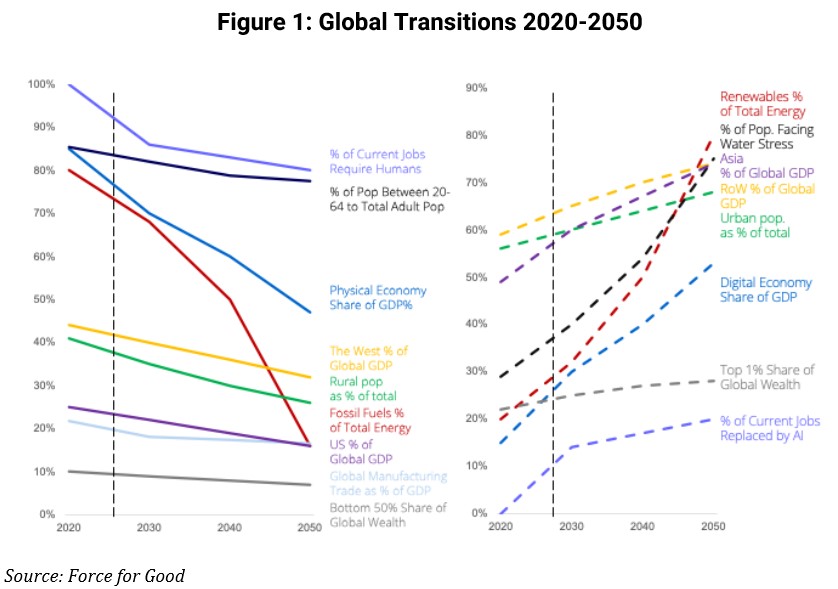
The unfolding of these transitions gives rise to a series of challenges for the world, and the next four years promise to be critical ones in determining how, and indeed whether, these challenges are met.
While the road ahead is inevitably disruptive, much like the major transition that led to the rise of industrial era, it is also a potential threat to world peace as industrial powers fight technological ones within countries and across borders, and countries continue compete for the old resources that defined the previous era until technological “America is already great. So, the question is really, will this presidency make it even greater, or will it damage it primacy, based on the declared agenda.” breakthroughs deliver solutions. There are several additional factors that further complicate this transition:: the potential for a multi-polar world is much discussed given the rise of China; the world moving from 6.2 billion to 10 billion people during the first half of the 21st century; global energy systems are disrupting the biosphere in ways which are highly destructive before its replacements have been put in place worldwide, and AI is already proving to be an intelligence that can enhance all aspects of human endeavour and potentially become a superior one too man. This Trump presidency has a critical bearing on all these matters.
American power has been built over the last two centuries, dated back to 1898, and today is the sole superpower. Its greatness is defined by its primacy on across both soft and particularly hard power (figure 2 below),
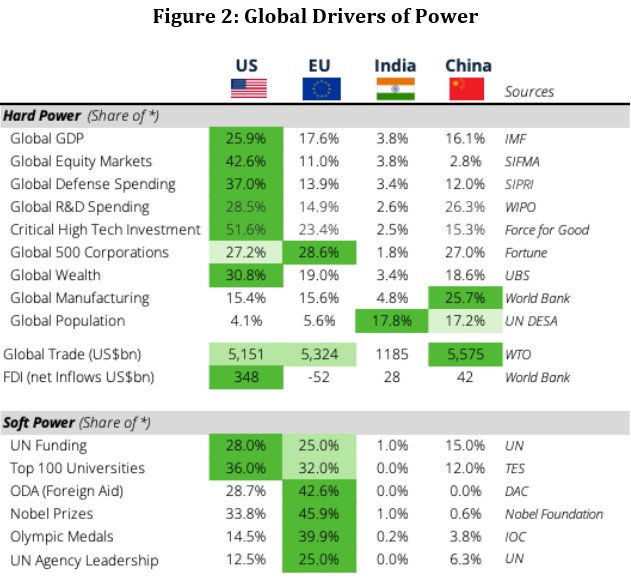
America is already great. So, the question is really, will this presidency make it even greater, or will it damage it primacy, based on the declared agenda. Success or failure may well be decided by the important choices and events regarding the following critical matters:
-
America’s Leadership. Is America about to do the ultimate Brexit – abandoning the liberal order?
-
A New Imperialism. Can America be expansionist and isolationist at the same time?
-
Oligarchs and Politics. What are the implications of the rise of the tech-industrial complex?
-
Liberalism’s Reinvention. Do liberals lack answers to fundamental working-class problems or are they losing because they cannot play dirty enough?
-
Populism and Regime Change. Can American money and technology propel right wing populists into power in democracies around the world?
-
Repositioning Europe. Can Europe position as a trusted power bloc and ally to the world in the face of disruptive change?
-
India Demographics. Is India’s scale ever going to drive benefits at the level of individuals or will population growth and inequality keep its masses poor?
-
Russian Containment. Will Putin be contained or will the dream of re-creating the Soviet Union now become possible as America shifts to spheres of influence?
-
China’s Contribution. Can China reposition in this time as an ally of the transition, or will it use disruptions to it tactical advantage?
-
Israel-Gaza Peace. Is regional security and peace ever possible?
-
The Middle East. Can the Middle East maintain energy leadership by transitioning with the world to renewables?
-
Climate and Sustainable Development. How will climate get funded, and is development aid throwing good money after bad or is there a better way to fund sustainable development?
Some of the challenges laid out above, such America’s role in the world, map cleanly onto the incoming president’s agenda, while others, such as the challenge of sustainable development, are likely far from his mind. All of them however will be fundamentally impacted during the next four years, whether for better or for worse.
1. America’s Leadership
‘The currently proposed tariffs of the Trump Administration would take the average tariff rate in the US to nearly 18%, its highest levels since the 1930s”1
Trump’s return promises to further accelerate a move away from a system of global rules and multi-lateral institutions toward a more transactional global system. Having disregarded for international norms and institutions during his first term, Trump’s current focus on protectionism, tariffs, and multi-lateral withdrawal, his intention to engage with countries bilaterally, and his stated desire to expand American territory are all potential nails in the coffin of the global order that America built. If America fully retreats from its role as the leader of the free world and the guarantor of the post war order, the resulting vacuum will either be filled by others, or it will create unprecedented global disorder.
Potential Positive Trajectory
Positive Transactions. If Trump’s transactional mode is rooted in the realisation that American leadership disproportionately benefits America over the long term. America therefore continues to play important geopolitical roles, albeit on more bilateral and commercially favourable terms.
Potential Negative Trajectory
Rising Disorder. The promise of short-term gains supersedes long-term benefits, leading to a world where America disregards climate change, global health crises and the SDGs to focus on a series of bilateral trade and security deals with both willing and unwilling partners.
Fundamental Test: Will this lead to the renewal of American power or will it ultimately alienate allies and strengthen rival powers and power groups?
2. A New Imperialism?
‘The United States will once again consider itself a growing nation — one that increases our wealth, expands our territory, builds our cities, raises our expectations, and carries our flag into new and beautiful horizons.”2
Donald Trump has widely been described as an isolationist and his ‘America First’ doctrine seems to imply an inward focus of priorities. However, Trump’s recent statements that he would reclaim the Panama Canal, takeover Greenland, and annex Canada, as well as his renaming of the Gulf of Mexico to the Gulf or America point to an expansionist rather than isolationist America during his second term. On the one hand, Trump has gone out of his way to praise President William McKinley, the last president to extend US territory (winning the Spanish American war, annexing Guam, the Philippines and Hawaii), on the other hand, he has formally endorsed the doctrine of another president, James Monroe, who declared that the US would not intervene in the affairs of European countries, and that any interference in the western hemisphere would be viewed as a hostile act.3 How can these two very different views can be reconciled?
Potential Positive Trajectory
Sphere of Influence Protected by Other Means. America’s sphere of influence in the Western Hemisphere is reinforced through a series of security and commercial deals meeting Trump’s protectionist and nationalist priorities without requiring territorial annexations or transfers of sovereignty.
Potential Negative Trajectory
American Expansionism. Weak bargaining power of counterparties combined with Trump’s desire to leave an extraordinary legacy lead to negotiated outcomes with de facto or even de jure extensions of US sovereignty in places like Panama and Greenland.
Fundamental Test: Will imperialism give America greater ability to exert its will in the longer term or create resistance and enmity?
3. Oligarchs and Politics
Five of the world’s ten richest people attended the second inauguration of Donald Trump4
Russia has shown the world what happens in political-economic oligarchies, and the consequences of vast accumulation of wealth and power when politics and business are woven into one force.5 Why will America be different? Led by Elon Musk, entrepreneur and the world’s richest man, Big Tech has rushed to embrace Donald Trump since his electoral victory. Having donated over US$250 million to Trump’s election campaign, Musk is entering the White House as the president’s right-hand man, appointed to run the “Department of Government Efficiency” tasked with cutting federal spending. Musk now has the potential to pursue both a political/policy agenda and a hyper-commercial one, which given his ownership of three global tech companies, SpaceX, Tesla and X, represent a significant conflict of interest. He has further been joined by fellow billionaires Jeff Bezos of Amazon and Mark Zuckerberg of Meta. Their efforts point to the potential to create an oligopolistic ‘tech-industrial complex’, with a small number of business leaders either becoming political actors, or at least exerting significant influence over the deregulation of their own industries.
Potential Positive Trajectory
Innovation Boom with Positive Impact. Deregulation and increased public spending on technology R&D drives an innovation boom with breakthroughs across AI, quantum computing, fusion that deliver a massive positive impact for the world over the long-term, institutional checks and balances remain in place to safeguard the nation and the world.
Potential Negative Trajectory
Emergence of Monopolies that Stifle Progress. Regulatory priorities are focused on protecting existing tech franchises, stifling competition, and reducing user and consumer protections, leading to incumbent monopolies that prioritise profit generation over long term innovation, corruption booms, civil rights dimmish, and unfettered AI creates an existential threat.
Fundamental Test: Will this strengthen America’s leadership in technology or strengthen the insider group of technologists?
4. Liberalism’s Reinvention
In 2024 incumbent political parties lost votes in every election globally, for the first time in 70 years6
Centrist and liberal political parties continue to lose ground to populist movements due to economic discontent, political polarization, and perceived detachment from voters. Seen as part of the political establishment that has failed to deliver to their electorates, centrists have struggled to address inequalities and globalization's adverse effects. Populists have successfully exploited this disillusionment by offering simplified solutions and framing themselves as the voice of "the people" against corrupt elites. Further, the simple and strong rhetoric of populists resonates much more powerfully with electorates than that of liberal parties. This dynamic has enabled populists to erode the appeal of traditional, consensus-driven politics and reshape national political narratives, despite lacking viable long-term solutions to the problems they are highlighting.
Potential Positive Trajectory
Liberalism Resets Itself. A rejuvenated liberal movement emerges that is rooted in prosperity, security and peaceful co-existence, eschewing extremes, with implementation credentials that provide a powerful counter-narrative to far-right populist contenders.
Potential Negative Trajectory
Slide to Authoritarianism. Liberalism’s continued failure to address global issues and its inability to connect with electorates leads to the continued hollowing out of liberal and democratic institutions, paving the way for more authoritarian governments across the West.
Fundamental Test: Can the ‘middle ground’ of politics be reimagined and made compelling to counter populist and highly charged right wing politics?
5. Populism and Regime Change
Populist parties won a total 263 of the 720 seats in the 2024 European Parliamentary elections — approximately 36% of the vote.7
Having used his bullhorn as the owner of social media platform X to promote Donald Trump to his 195 million followers in the US election, providing $24 million worth of free advertising, Elon Musk is now endorsing far-right parties and leaders in Europe, disseminating disinformation and partisan rhetoric favouring Reform in the UK and the AfD in Germany. While the political establishment in Europe has decried his efforts as election interference, the power of money and technology to validate fringe movements and disrupt political stability is evident. With far right and populist parties having gained significant ground across nearly all European election in 2024, the question now is whether the combination of foreign money and technology have the potential to tip the scales to drive regime change.
Potential Positive Trajectory
Institutional and Political Firewalls Hold. Existing European laws and regulations concerning campaign finance successfully limit the impact of money and technology on future elections, with multi-party firewalls against far-right populists further limiting these parties’ abilities to form governments.
Potential Negative Trajectory
The Breakup of the EU. The playbook first deployed in the UK to support Brexit, then the US 2024 election, nudges the European electoral map over the edge. Centrist parties are compromised by their coalitions with National Populists and undermine the EU or a far-right party in a key EU state wins and leaves the EU, breaking up the EU core.
Fundamental Test: Is global stability more likely with a united EU, and is America stronger working in tandem with the biggest trading bloc in the world it against its competitors?
6. Repositioning Europe
Despite the EU touted as one of the largest economies in the world, with 440 million consumers, and the world's largest trading bloc, its growth and competitiveness is slowing and projected to decline.8
Europe’s share of global GDP has halved since 1980, to 15% currently, while that of the US has remained at 25% and Asia’s has increased to 38%9. The EU has the second largest GDP after America and the second largest exports after China10. However, it continues to lose geopolitical and economic power, with GDP growth at 1% in 2035, plagued by the challenges of coordination of member states, and a strained Franco-German leadership. Europe is seen to have failed to make a difference to the Israel-Gaza war, Russia’s war in Ukraine or mass migration, and most European NATO members are struggling to spend the target 2% of GDP on defence. It has shown leadership in climate and sustainability as a rule maker, with the economic and commercial benefits to be harvested. Europe’s (and the EU’s) continued global relevance will therefore depend on its ability to position itself as a power bloc, which will require internal unity, addressing broader security issues and executing a long-term growth strategy that integrates candidate countries and extends its global influence.
Potential Positive Trajectory
Stability at the Core. The upcoming German election returns a strong mandate to a pro-EU government that take a leading role to drive pragmatic EU-wide deals on immigration and regional security, providing the basis for a broader renewal and strengthening of the Union’s position in the world at a critical juncture for the world as it struggles with the Trump Administration, the SDGs, Climate Change and the transition to the information era.
Potential Negative Trajectory
Vulnerable to Force of Decline and Break-up. If the EU fails to muster an effective response to internal and external challenges, it risks undermining unity in the Union precluding coordinated action on economic, social, political or defence opportunities, and making itself vulnerable to forces that wish its demise.
Fundamental Test: Can the EU leverage its scale, collective national strengths and its global trading relationships to position for the resolution of major global issues, the voice of reason and the one to trust in a chaotic world?
7. India’s Demographic Dividend
India is the 5th largest economy with only 97 million salaried jobs for a total working age population of nearly one billion people11
India has been amongst the fastest growing large countries recently with an average real GDP growth of 7.3% over the last three years and its GDP has expanded by US$1.2 trillion since the pandemic to reach c.US$4 trillion in 2024. Its leadership and population aspire for India to rise to be a developed country and a pre-eminent global economic superpower by the middle of this century. However, growth in India has been uneven and inequality has increased, with the richest 10% now owning c.80% of its wealth (vs. 3% for the bottom 50%), and 44% of the country, or over 600 million people, still live below lower middle-income levels. Private sector job growth has not kept pace with the growing working age population and agriculture still accounts for 45% of employment (but only 16% of GDP). For India to reach upper middle-income levels and emerge as a 21st-century economic superpower, it must ensure inclusive, regionally balanced growth and generate large-scale, high-quality employment to accommodate its expanding workforce, an elusive challenge the world over.
Potential Positive Trajectory
Step Change in Private Sector Job Creation Drives Inclusive Growth. India leverages its strengths in engineering and technology to become a global leader in the sectors driving the fourth industrial revolution, thereby driving large-scale white-collar job creation for its youth, and creating a multiplier impact on other sectors in the economy.
Potential Negative Trajectory
Automation and Stalled Reforms Lead to Increased Inequality. The combination of AI-driven automation and stalled reforms momentum leads to workforce additions outpacing new private job creation, leading to the increased consolidation of wealth with the country’s richest, and setting the scene for swings to the left and then the right but both populists that cannot deliver.
Fundamental Test: Can India outpace its demographics with entrepreneurism and industrial scaling for the information age?
8. Russian Containment
Russian hybrid warfare activities across Europe increased to 44 incidents in 2024, up from 13 in 202312
Putin has overturned the West’s assumption that Russia was no longer a great power after the fall of the Berlin Wall, Russia’s support for Syria’s regime led to a mass exodus into the EU which destabilised the whole region’s politics, its war in Ukraine have tested NATO’s unity and delivered an energy crisis to Europe and the world, and its alignment with China and Iran and the broader BRICS group create new power structures. The end game is still uncertain for both the West as well as Russia.
Potential Positive Trajectory
Trump’s Grand Strategy. President Trump resists the urge for a short-term win in Ukraine in favour of a longer-term strategy to both engage and contain Russia, strengthening NATO’s eastern flank, reducing European dependence on Russian energy, enforcing tech and financial sanctions, and supporting democratic resilience and economic growth in former Soviet countries, while finding a way to respect and re-engage Russia on major global initiatives as a partner.
Potential Negative Trajectory
Short-term Win – and Long-term Costs. The opportunity to secure a short-term win in terms of a ceasefire proves to be irresistible to President Trump, leading to a deal favourable to Russia and emboldening Putin to continue to destabilise Europe, including election interference, assassinations and cyberattacks, while advancing a sphere of influence transaction with the Trump administration.
Fundamental Test: Are American and world peace best served with Russia having a physical sphere of influence or a constructive role in solving global issues and what does it take to satisfy Russia’s needs?
9. China’s Contribution
China has invested over US$1 trillion in overseas direct investments across the 150 countries active in its Belt and Road Initiative since 201313
Trump’s second term comes at a challenging time for China, as the world’s second-largest economy grapples with a prolonged property crisis, mounting local government debt, and rising youth unemployment. The threatened 60% tariffs on Chinese exports will put significant pressure on an economy that is only slowly diversifying away from manufacturing, and an escalating trade war risks leading to export controls on critical technologies that China needs for its future. However, Trump’s transactional attitude towards regional allies also creates potential opportunities for China to exploit, particularly with regards to Taiwan and territorial disputes, where in the absence of strong multilateral safeguards China too can bring its weight to bear against smaller countries in bilateral engagement. The alternative for China is to lean into constructive engagement globally, strengthening existing and creating new multilateral initiatives across the world that build its global influence in the absence of US leadership.
Potential Positive Trajectory
Strategic Leadership. China strategically steps into the vacuum left by America’s transactional approach and seeming withdrawal from positive mutually beneficial global leadership, reaffirming multi-lateral institutions and frameworks, and building broad based international coalitions (under its own leadership) to advance global issues like the energy transition and climate change.
Potential Negative Trajectory
Opportunistic Wins. China uses the incidents and disruptions created by the Trump administration as opportunities to tactically further its own objectives in Taiwan, the South China Seas and other places, circumventing multilateral institutions to bring its weight to bear in uneven bilateral engagements.
Fundamental Test: Will China use this period of great uncertainty, predatory behaviour and transactionalism as an opportunity to forge deeper and broader relationships around the world?
10. Israel-Gaza Peace
Over 2% of the population of Gaza has been killed in the conflict between Israel and Hamas in just over one year, approaching the c.2.5% death toll of the nearly 14 year-long Syrian Civil War14
Following 15 months of conflict, Israel and Hamas have agreed a temporary six-week ceasefire and a deal to free the 98 hostages still in captivity. Following an initial hostage release negotiations remain underway for a permanent ceasefire and a full withdrawal of Israeli troops from Gaza. This conflict has seen 47,000 deaths, over 100,000 buildings destroyed in Gaza, a warrant issued by the International Criminal Court for the arrest of Israel’s Prime Minister, and the country’s international reputation at an all-time low. Against this backdrop the key question is whether the current fragile truce can lead to long term security in the region for both Israelis and Palestinian, or whether it stores up more violence to be unleashed later. The answer will depend on reaching agreement not just on the reconstruction and governance of Gaza but also on the political future for Palestinians, questions that will require significant support from the US government to be addressed.
Potential Positive Trajectory
Forging Short Term Co-existence as a Path to Longer Term Peace. Under US pressure both parties use the breathing room of the truce to agree a longer-term ceasefire, with the EU and Gulf countries underwriting a plan (backed by Trump) to rebuild Gaza. With the immediate threat removed, moderate parties in Isael oust the current government and restart the two-state solution process with Palestine to reach a partition that each side can live with.
Potential Negative Trajectory
Cycles of Violence Unbroken. If following the agreement of a temporary ceasefire Trump gives carte blanche to the current Israeli government regarding Gazan governance and West Bank settlement policies, this stores up Palestinian resentment in both Gaza and the West Bank, building up for another future cycle of violence, which only Israel is armed to do at scale, but traumatises both sides.
Fundamental Test: Was the ceasefire the first step in creating peace and security for all, given history shows that if it cannot be created for all, it will last for no one?
11. The Middle East and Energy
Clean energy investment in the Middle East accounts for only 15% of the total US$175 billion energy investment made in 2024, against a global average of 66% 15
Despite the second Trump administration intention to “drill, baby drill”, investor pressure and the sector’s sensitivity to oil prices are expected to see the growth of oil production flattening by next year[ii], and the rest of the world is continuing to decarbonise its energy systems with major powers trying to establish leadership in clean energy and related areas. The strategic question this raises for the Middle East, a region whose wealth and geopolitical influence has been built on the back of oil and gas, is how to maintain its traditional energy leadership.
Potential Positive Trajectory
Middle East Positions as the Energy Leader. If the Middle East reinvests its surpluses from oil and gas in clean and breakthrough energies, it can establish itself as a leader in the global energy transition. This could form the basis of being a long-term ally of the energy solutions of the future and provide it the means to be a funder of progress across the Global South, where large potential future markets remain to be realized.
Potential Negative Trajectory
Middle East Diversifies its Sources of Value and Funds the Breakthroughs Needed. If the Middle East follows America’s decision to pump fossil fuels, taking a backseat position in new energies, it ultimately loses its core revenue sources to innovators, and while some may have diversified and positioned for leisure and entertainment, and others as a financial hub, most of the region lacks a core wealth security platform, and lives off the past.
Fundamental Test: Can the Gulf States scale investments and innovation in alternative energies quickly enough to build leadership positions as the global energy transition unfolds?
12. Climate and Sustainable Development
Despite the transfer of over US$1 trillion in cumulative development aid, real per capita incomes in Africa are lower than they were in the 1970s16
The climate transition to global net zero requires US$266 trillion of cumulative spend through 205017
The UN Sustainable Development Goals (SDGs) encompassing progress on environment and people, are failing. Despite global efforts, none of the 17 goals are on track to be met by the 2030 target date and current global development aid represents only a fraction of the incremental US$14-17 trillion of annual spending that is required to the meet and sustain the SDGs. Further, President Trump has withdrawn from the Paris Agreement, decided to promote oil and gas, and appears to be considering transforming the US Development Finance Corporation from a multi-lateral development bank into a sovereign wealth fund, a move that would radically shift foreign aid priorities from sustainable development to generating returns and progressing US strategic interests.
Potential Positive Trajectory
Policy Changes Unlock Market-Based Solutions. Climate technology and energy breakthroughs continue to attract investment while oil and gas do not,18 and policy reforms across the Global South transform key development needs into commercial opportunities, allowing private sector capital to flow to scaled solutions that unlock significant sustainable development progress.19
Potential Negative Trajectory
Foreign aid spending by industrialised countries declines as other rich countries follow America’s example, with climate change under-funded, and the foreign aid that continues to flow fails to have a meaningful development impact across major recipient countries.
Fundamental Test: Will America cede the climate and energy technology space and the Global South to China and others?
The Modus Operandi for the World to Contend With
For nearly all the challenges laid out above, the real swing factor between the positive and negative outcomes described is President Trump himself, with his decisions potentially setting the trajectories that these issues will follow long after his term ends. Trump may well be the most consequential president of the century if that is the case.
Trump has by now conclusively demonstrated his capacity for action, not only doing deals that other leaders have struggled with but also compelling others to do them too, albeit these may have dire consequences (e.g. the Abraham Accords may have inadvertently catalysed the Israel-Hamas war). Moreover, even Trump’s rhetoric has proven to have significant causal power, having both stopped wars (in Gaza) and escalated them (in Ukraine currently). The key questions therefore are what Trump’s real priorities will be, what parts of his agenda he will seek to action, and how the world will respond. While this is uncertain, there are several factors that may be critical in shaping Trump’s likely play book and the world’s strategies to respond to it, adding up to a potential modus operandi that reveals much about the path ahead for America and the world.
-
Pragmatism Over Ideology. The age of idealism is over for now, and the model has shifted to prioritizing outcomes over values-based diplomacy, focusing on immediate national benefits in trade and foreign policy, ignoring issues such as human rights in favour of securing agreements, seeking short-term economic and geopolitical wins, as seen previously in NAFTA renegotiation, tariffs on China, and withdrawals from the Iran Nuclear Deal and Paris Agreement.
-
The Most Powerful Oligarchy in the World. While Russia’s oligarchy rose in the disorder following the economic and political collapse of a superpower, America’s is forming in the most powerful, richest nation on earth. If historical precedents on political-business oligarchies hold true, power abuse, coercion, extortion and corruption are set to engulf America and become increasingly evident in its dealings with the world at large, initially capable of delivering peace and prosperity, but inevitably collapsing into tyranny that silences dissent, with the mid-terms and the next presidential election acting as a potential safety valve.
-
The Competing Priorities of the MAGA Hydra. Trump’s hands-off leadership style allows competing factions - libertarians, Silicon Valley elites, and Christian nationalists - to push conflicting agendas. Past infighting, as seen in high-profile White House departures, could resurface, with key figures already positioning for a post-2028 landscape.
-
Global Response and Adaptation. The world, now accustomed to Trump’s unorthodox diplomacy, will respond with a mix of fear and loathing, some countries offering headline grabbing wins, like Saudi Arabia’s US$600 billion four-year U.S. investment commitment, while others resisting (Canada and Norway-Greenland on territorial matters) or escalating tensions (Russia in Ukraine) in response to his confrontational style.
-
Confrontation and Coarsening of Dialogue. Political and diplomatic discourse is expected to further deteriorate, with inflammatory rhetoric, open hostility toward critics, and an intensified use of social media to attack adversaries. Trump’s approach will likely embolden political actors worldwide to abandon diplomatic decorum in favour of aggressive, populist communication styles.
-
Might is Right Approach Spreading. A second Trump term could reinforce a global trend toward power-based diplomacy, where military and economic coercion increasingly replace consensus-driven international engagement. This approach may embolden other strongman leaders to act aggressively at home and unilaterally abroad, escalating territorial disputes, trade wars, and military conflicts.
-
The U.S. Example Spreading. Trump's policies, on expelling migrants, reversing climate commitments, and deploying inflammatory rhetoric, likely inspire similar moves by populist leaders globally. Countries facing migration crises, economic strain, or political polarization could follow suit, further weakening international cooperation on key issues such as human rights, climate change, and democratic governance.
-
Institutional Erosion and the Decline of Multilateralism. A second Trump term may accelerate the weakening of global institutions such as the UN, NATO, and the WTO, as the U.S. shifts toward unilateral and transactional engagements. Reduced U.S. participation in multilateral agreements could embolden other nations to sidestep international norms, leading to a more fragmented global order.
-
The Normalization of Crisis Politics. Trump’s governance style thrives on disruption and unpredictability, creating a cycle where political and economic instability becomes the norm rather than the exception. Whether through trade wars, brinkmanship with adversaries, or escalating tensions with domestic opposition, this pattern may encourage other leaders to embrace similar high-risk strategies, increasing global volatility.
-
Strategic Legacy Building. With a finite second term, Trump may shift from immediate payoffs to securing an enduring international legacy, possibly through high-profile diplomatic moves or a Nobel Peace Prize bid, similar to his past overtures toward North Korea.
Conclusion
The compelling nature of Trump’s rhetoric and showmanship, magnified by a global media that continues to be mesmerised by him, and the antics of superstar supporters on social media are leading to the passionate opposition for everything he stands for by his detractors and to open adoration by his supporters. This is the nature of the extreme divide.
However, the fundamental test of whether Trump brings positive change that makes America great (remembering it is already great and there is no country that rivals it today) or one that sets it back or down in power and position is something that is both measurable and judgeable.
The United States has spent over two centuries consolidating its position as the world’s dominant superpower. Its leadership is built on unmatched economic strength, military superiority, technological innovation, and global “Whether Trump makes America greater or sets it back in terms of its power and position can be measured and determined.” influence. The U.S. remains the world’s largest economy, home to industry-defining corporations and the leader in almost all of 19 emerging technologies shaping the next era. Its military remains unrivalled, backed by an extensive network of global alliances. Beyond hard power, the U.S. wields significant leverage through its control and influence over major international institutions, from the UN to the World Bank, shaping global policy and maintaining the liberal international order. America remains the centre of global power. The key question, therefore, is whether this presidency will bolster its primacy or erode the foundations of its leadership.
Fundamental Tests of the Success of the Trump Presidency
| Fundamental Test | Success Trajectory | Failure Trajectory |
|---|---|---|
| America’s Leadership | Transactional leadership strengthens U.S. power while maintaining geopolitical stability. | U.S. retreats, leading to global disorder and strengthening rival powers. |
| A New Imperialism | U.S. reinforces its influence through strategic agreements rather than territorial expansion. | Expansionist policies create resistance, instability, and diplomatic isolation. |
| Oligarchs and Politics | Tech-driven innovation boom with broad economic and societal benefits. | Oligopolistic monopolies stifle competition, prioritize profits over progress, corrupting business and politics. |
| Liberalism’s Re-invention | Liberal institutions adapt, regaining voter trust and relevance. | Populism overtakes liberal democracy, leading to authoritarianism. |
| Populism and Regime Change | European institutions limit far-right influence, maintaining stability. | Populist surge weakens democratic institutions, leading to European fragmentation. |
| Re-Positioning Europe | EU consolidates internal strength, maintaining global influence. | EU stagnates, losing economic and geopolitical relevance. |
| India Demographics | India creates large-scale high-quality jobs, ensuring inclusive growth. | Job growth lags, increasing inequality and political instability. |
| Russian Containment | U.S. balances containment with engagement, reducing global instability. | Short-term U.S. deals embolden Russia, increasing global threats. |
| China’s Contribution | China adapts constructively to global uncertainty, avoiding aggressive expansion. | China exploits uncertainty to expand influence through coercion. |
| Israel-Gaza Peace | Ceasefire leads to long-term peace efforts with global support. | Cycle of violence continues, escalating regional instability. |
| Middle East & Energy | Middle East leads in energy transition and innovation funding. | Middle East remains dependent on fossil fuels, missing global shifts. |
| Climate and Sustainable Development | Policy shifts enable market-driven climate and development solutions. | Climate funding declines, stalling progress and worsening global disparities. |
A second Trump administration presents a complex global dynamic to navigate. While his transactional approach, focus on short-term national gains, and aversion to multilateralism pose challenges, the extent of global disruption will depend on how other nations adapt. However, if key players strategically counterbalance U.S. policies - through tactical concessions, institutional resilience, and economic diversification - the world may survive this while actually becoming more cohesive and focused on working together on the major issues facing them in common. However, if Trump’s leadership accelerates a more general shift across the world in democracies too toward power-based diplomacy, unilateral decision-making, and the erosion of global institutions, the international system could face significant fragmentation and volatility, seeing human security for all decline.
Beyond economic and diplomatic realignments, Trump’s leadership may further entrench a "might is right" approach in global affairs, shifting the world to one where the strongest do what they can, at the expense and “Will this presidency strengthen American primacy, or will it weaken its position in a world where power is increasingly contested?” sufferance of the weakest. His rhetoric and policies may also inspire a wave of political copycats, from aggressive re-migration policies to reversals on climate commitments, further weakening international cooperation on critical global issues. US corporations, from banks to technology companies, have already fallen in line behind the president’s agenda on several of these topics. Opportunistic (or daresay pragmatic) international leaders may likely do so as well. The erosion of institutional multilateralism, coupled with the normalization of crisis politics and confrontational dialogue, could create a more fragmented and volatile geopolitical environment.
The nature of U.S. leadership will shape this evolving landscape. Oligarchies present unique challenges and this one can be the most powerful in the world, which history shows leads to the greatest corruption of interests and the largest loss of civil rights. If America becomes sufficiently predatory and self-interested, and if its retreat from multilateralism and mutually beneficial dealings is prolonged, it risks incentivising others to form coalitions to counter its power, which China, Russia, and other BRICS nations (which in its expanded form now collectively represents 56.4% of the global population) are preparing to do. The European Union, long a defender of the liberal international order, will also have the opportunity to lead in these times as a guardian of values it shares with others if it can adequately reform itself. India, the world’s fastest-growing major economy, has the potential to emerge as a stabilizing force, modelling a sustainable path to economic expansion which the recent elections there show its democracy demands. China could reposition itself as an ally of the rest of the world with its financial, technological and engineering resources. The Middle East, a powerful global investor can focus its resources on energy innovation and lead in the energy transition. And Japan, Canada, Australia and Northern Europe remain some of the deepest pockets of financial assets that can choose to invest strategically to expand their global reach and drive positive development. Questions of vision, will, and leadership will be the deciding factors.
Ultimately, the future global order under Trump 2.0 will be shaped both by the president’s actions and by how nations respond to the shifting reality he creates. Those that engage tactically, leveraging economic strength, regional alliances, and diplomatic pragmatism, may mitigate the most destabilizing effects of this episode in American power. In this environment, global actors have as much agency in defining the next era of world politics as Washington itself.
The fundamental question for Americans is will this presidency strengthen American primacy, or will it weaken its position in a world where power is increasingly contested? For the world, the equivalent question is even more important, will this presidency weaken the rest of the world, or will it unite them to act on advancing the world, in which case they may have the president to thank for that.
The Leader: Endnotes
-
York, E. (2024, October 1). Trump’s tariff proposals would raise tariff rates to Great Depression-era levels. Tax Foundation. https://taxfoundation.org/blog/trump-mckinley-tariffs-great-depression/
-
The White House. (2025, January 20). The inaugural address. https://www.whitehouse.gov/remarks/2025/01/the-inaugural-address/
-
Trump, D. J. (2018, September 25). Remarks by President Trump to the 73rd Session of the United Nations General Assembly | New York, NY. Trump White House Archives. https://trumpwhitehouse.archives.gov/briefings-statements/remarks-president-trump-73rd-session-united-nations-general-assembly-new-york-ny/
-
Washington Post. (2024, December 15). Elon Musk put $277 million into the election. He’s $200 billion richer this year. Bloomberg Billionaires Index. https://www.washingtonpost.com/business/2024/12/15/elon-musk-trump-election-wealth/
-
Markus, S. (2017). Oligarchs and corruption in Putin's Russia: Of sand castles and geopolitical volunteering. Georgetown Journal of International Affairs, 26-32.
-
Burn-Murdoch, J. (2024). Democrats join 2024’s graveyard of incumbents. Financial Times https://www.ft.com/content/e8ac09ea-c300-4249-af7d-109003afb893
-
Politico. (n.d.). EU election hub: European Parliament election poll of polls. Politico Europe. https://www.politico.eu/europe-poll-of-polls/european-parliament-election/
-
European Commission. (n.d.). EU position in world trade. https://policy.trade.ec.europa.eu/eu-trade-relationships-country-and-region/eu-position-world-trade_en
-
International Monetary Fund. (2023, October). World Economic Outlook database. International Monetary Fund. https://www.imf.org/en/Publications/WEO/weo-database/2023/October
-
International Monetary Fund. (2024). World Economic Outlook Database, October 2024. Retrieved from https://www.imf.org/en/Publications/WEO/weo-database/2024/October World Bank. (2024). Global Economic Prospects, June 2024. Retrieved from https://www.worldbank.org/en/publication/global-economic-prospects
-
GPC analysis based on data from various sources including World Bank, ILO and CEIC: Greater Pacific Capital. (2023, September). India’s G20 presidency spotlighted the drivers of its growth engine. https://www.greaterpacificcapital.com/thought-leadership/indias-g20-presidency-spotlighted-the-drivers-of-its-growth-engine
-
Leiden University. (2025, January 20). Research: Europe increasingly targeted by Russian sabotage. https://www.universiteitleiden.nl/en/news/2025/01/research-europe-increasingly-targeted-by-russian-sabotage; The Parliament Magazine. (2025, January 21). Hybrid threats: Russia’s shadow war escalates across Europe. https://www.theparliamentmagazine.eu/news/article/hybrid-threats-russias-shadow-war-escalates-across-europe
-
Nedopil, C. (2024, February). China Belt and Road Initiative (BRI) investment report 2023. Griffith University. https://web.archive.org/web/20230602141018/https://www.globalr2p.org/countries/syria/; UN OCHA.
-
Global Center for the Responsibility to Protect. (n.d.). Syria. Retrieved from Internet Archive on January 27, 2025, from https://web.archive.org/web/20230602141018/https://www.globalr2p.org/countries/syria/; United Nations Office for the Coordination of Humanitarian Affairs. (2025, January 8). Reported impact snapshot | Gaza Strip. Retrieved January 27, 2025, from https://www.globalr2p.org/countries/syria/
-
International Energy Agency. (2024). World energy investment 2024: Overview and key findings. https://www.iea.org/reports/world-energy-investment-2024/overview-and-key-findings
-
Moyo, D. (2009). Dead aid: Why aid is not working and how there is a better way for Africa. Farrar, Straus and Giroux.
-
Climate Policy Initiative. (2023). Top-down climate finance needs. Climate Policy Initiative. https://www.climatepolicyinitiative.org/publication/top-down-climate-finance-needs
-
Financial Times. (2025, January 24). Wall Street will stymie Donald Trump's US oil surge plan, say shale executives. Financial Times. https://www.ft.com/content/3f4c07ee-7a75-467d-9cc7-53e81c579874
-
Bloomberg Philanthropies & Goldman Sachs. (2023). Catalyzing $500 million of investment in the clean energy transition in South and Southeast Asia. Bloomberg Philanthropies. https://www.bloomberg.org/press/bloomberg-philanthropies-and-goldman-sachs-catalyse-500-million-of-investment-in-the-clean-energy-transition-in-south-and-southeast-asia


