
With the climate crisis increasingly manifesting in global weather patterns, and the last decade being the hottest on record1, the global transition towards clean energy and a Net Zero emissions trajectory has become critical. The estimated insurance protection gap stands at US$2.8 trillion in 2020 which insurers expect climate to exacerbate2 .
With India’s widely expected ascent into an economic superpower by mid-century (with a GDP of US$40-50 trillion by 20503), the die will be cast in terms of whether this supports the global energy transition or not in the next few years as India’s economy crosses c.US$4 trillion this year, and scales to US$7-8 trillion to become the third largest economy globally by 20304. This transition would see India rapidly rise to an upper middle-income economy by the late 2030s and to a high-income economy after 20505.
Such an economic transformation, at this scale, has only one precedent – China’s – which saw its economy grow 15-fold since the turn of the century (from c.US$1.2 trillion in 2000 to c.US$18 trillion in 20236). However, this growth came at a significant environmental cost: China’s CO2 emission increased three-fold during this period (from 4.3 billion tons in 2000 to 12.6 billion tons in 2023), and it is now emitting more than twice as much CO2 as the US (though on a per capita basis, China’s emissions are still half of the US’, at c.8 tons per capita).
India’s economy is currently far less carbon intensive relative to the US’ and China’s (with c.2 tons of emissions per capita), but given its scale, it has already become the third largest CO2 emitter globally accounting for c.7% of global carbon emissions in 20237. If India follows the carbon-intensive model of growth that China did over the last 20-30 years, the environmental impact for India and the world could be devastating, and it could singlehandedly derail global Net Zero objectives, notwithstanding progress made elsewhere.
Fortunately for the world, India seems to have recognised this, and the country has made a commitment to reach Net Zero emissions by 2070, along with significant investments in energy efficiency and renewables that have put it on track to meet its 2030 targets to reduce the energy intensity of its economy by 45% (vs. 2005 levels) and to increase the share of fossil-fuel free power generation to 50%8.
However, even these ambitious 2030 targets are insufficient relative to the trajectory that India needs to be on to limit global warming to below 1.5OC (above pre-industrial levels) that scientists believe is necessary to avoid the worst impacts of climate change, and closer to a trajectory that would result in c.3.0OC of warming9. Moreover, it is only a fraction of the progress that India will need to make by 2050, by when its economy is expected be at upper middle-income levels of consumption, and 6-7x larger vs. 2030.
India’s key challenge is ensuring that it has sufficient energy to drive economic growth with energy security, while simultaneously ensuring that it decarbonises and creates a more energy efficient economy. There is simply no precedent for this: both the US and China’s transitions to upper middle-income economies were highly fossil-fuel intensive. And it will therefore be incumbent on the rest of the world to rise to help India meet this challenge, in terms of financing, technology transfer and other types of support. Asking India not to grow is not a real option.
This month’s Sign looks at India’s energy transition through a series of charts which highlight the importance of its transition not only for the country, but the world, and the implications for policymakers and financiers in India and globally.
India’s Energy Transition – What the Numbers Reveal
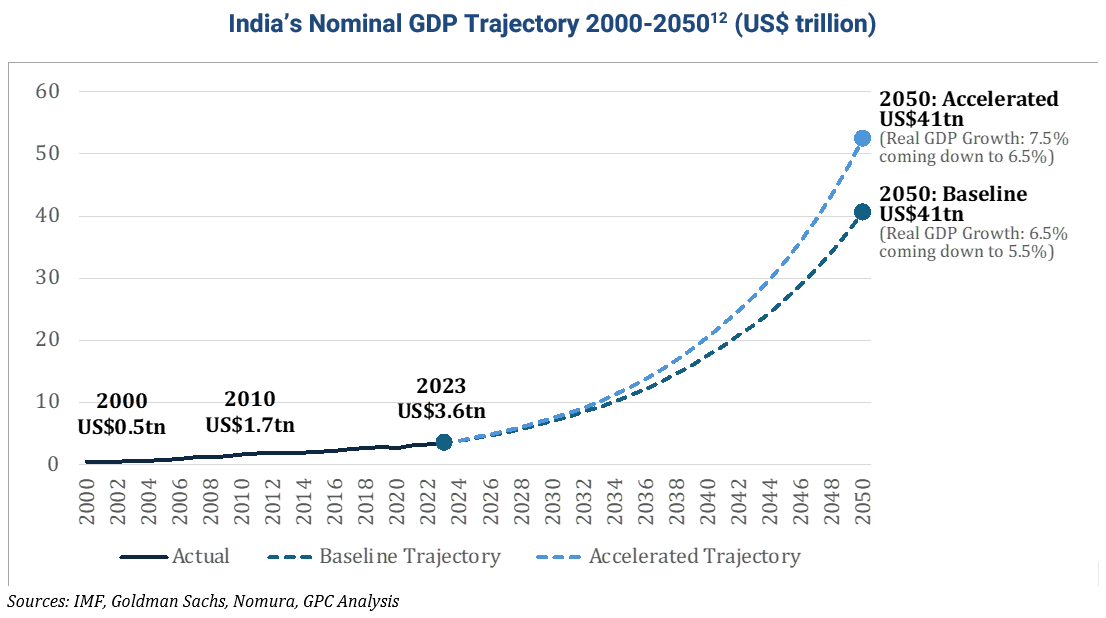
India’s Economy is Expected to Grow 11-15x by 2050. India is the fastest-growing major economy globally with c.8% real GDP growth last year and expected to grow at c.6.5-7.5% between 2024 and 202510. Extrapolating this growth to 2050, even with growth slowing due to a higher base, the economy is expected to grow to US$40-52 trillion (in nominal terms) by the middle of the century, implying per capita GDP of c.US$24,000-31,00011.
India’s Energy Consumption Expected to be At Least Double by 2050. As the economy grows, so too will India’s energy needs. Primary energy consumption in 2050 is expected to be 90% higher vs. 2022 in the Baseline Scenario above13, implying c.2.3% annualised growth in energy needs. Importantly, these estimates already assume that India’s economy will become significantly more energy efficient by 2050, with energy consumption per US$ of GDP declining by c.80%14, or c.40% below the US’ energy intensity currently. In case India’s economy grows faster and/or growth is more energy-intensive than expected, then India’s energy consumption in 2050 could be significantly higher than these estimates. A Net Zero trajectory would require India to become even more energy efficient – c.63% lower than the US economy today – and for its energy mix to shift far more decisively away from fossil fuels to renewables.

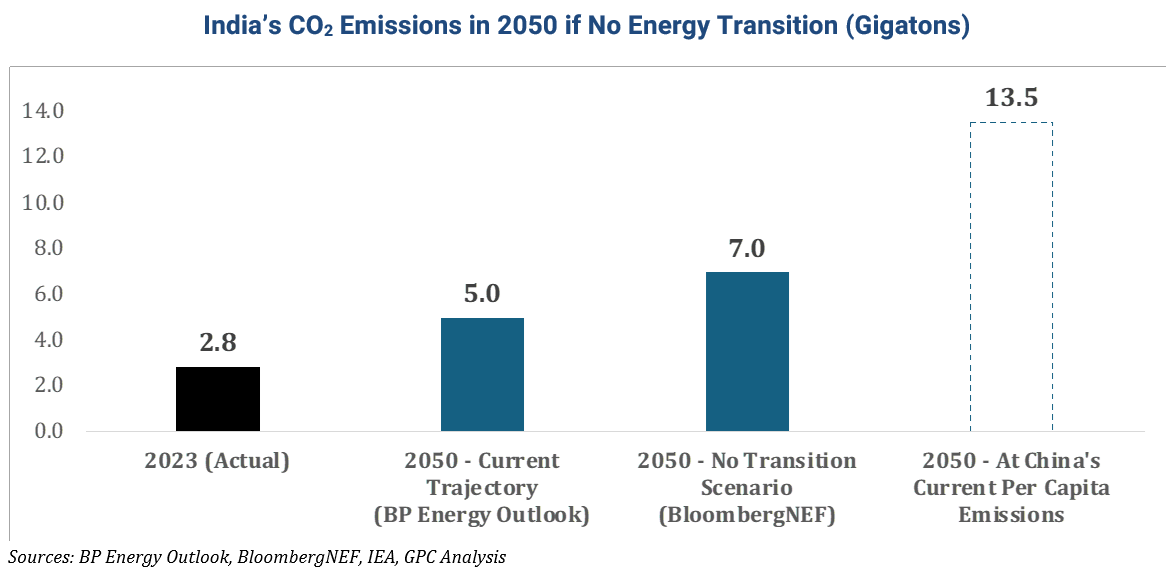
India’s CO2 Emissions Could Increase by 2.2-4.2 Gigatons by 2050 at the Current Trajectory. Based on the current trajectory of the change in India’s sources of energy, India’s CO2 emissions would increase to c.5.0 gigatons by 205015, and in case there is no further change in its fuel mix, they would increase to c.7.0 gigatons16. In the latter scenario, India’s per capita emissions would still be c.50% lower than China’s current levels (4.2 tons of CO2 per person vs. 8.1 tons in China as of 202317 ). In the hypothetical scenario where India follows China’s fossil fuel intensive model of growth and per capita emissions rise to similar levels as China’s today, India’s emissions would reach 13.5 gigatons, c.20% higher than China’s emissions in 2023 (given India’s larger population in 2050) and 2.7x higher than US’ emissions in 2023. Even the lowest of these scenarios is consistent with a global average temperature increase of over 3.0OC, and in the other scenarios, the rest of the world would likely need to go well beyond Net Zero emissions in 2050 to ensure that global warming can be limited to even those perilous level18.
A “Viability-Driven” Transition (Without Emissions Constraints) Would Still Derail Global Net Zero Objectives. Even in a scenario where India was to successfully transition its energy mix towards renewables and its transport sector towards electric vehicles based on their commercial viability potential as outlined in BloombergNEF’s “Economic Transition Scenario (ETS)”19, without explicit emissions constraints and major climate policy interventions and investments to limit emissions from industry and move the power sector more decisively towards renewables, India’s CO2 emissions in 2050 would still exceed 3.0 gigatons (vs. the 7.0 gigatons if there is no transition noted above), which is consistent with a 2.6OC global warming outcome. Based on its current targets and commitments, India appears to be headed down this long-term emissions trajectory.

Achieving Net Zero by 2050 will Require More Aggressive Interventions to Phase Out Coal and Oil and Deploy Multiple Clean Energy Solutions. While deploying solar and wind power capacity and electrifying transport through a shift to electric vehicles, based on the current commercial viability of these solutions, are still the biggest likely drivers of emissions reductions, these solutions will not be enough for India to achieve Net Zero emissions by 2050 and limit global warming to 1.5-2.0OC. Doing so would require India to completely phase out fossil fuels (and in particular coal on which India is disproportionately reliant) by mid-century, and replace these with other solutions including rapidly decarbonising the power system through incremental investments including in grid and storage infrastructure, more aggressively electrifying road transport and aiming for 100% share of EVs in new vehicle sales by 2040, and carbon capture and storage and decarbonisation of sources of energy used by large industrial sectors (steel, aluminium, cement, chemicals, construction, etc.)20.

Achieving Net Zero by 2050 will Require US$13 Trillion of Investment by 2050 Across a Range of Climate Solutions. Significant investments will be needed in energy infrastructure for either of the two transition scenarios above (Economic Transition and Net Zero). The Economic Transition Scenario would require investments of c.US$260 billion annually between 2022-2050, or cumulatively US$7.6 trillion with the primary drivers being EVs, renewable energy, electricity grids, sustainable materials, and fossil fuel processes. The investment requirements for the Net Zero Scenario are nearly 70% higher, or c.US$440 billion annually until 2050, or cumulatively US$12.7 trillion. The additional areas of investment carbon capture and storage, hydrogen power, heat pumps, in addition to incremental investments in all the areas in the Economic Transition Scenario.

For the world, the rationale for the call to cut back carbon and transition to clean energy solutions and value chains is clear. However, the proposition that India should in any way limit its growth and not take hundreds of millions of its people into prosperity is not a tenable one, particularly given that all other major powers took a carbon-intensive path to get there. It is a suggestion that India is particularly sensitive to, and perceives as the intention behind criticism of its 2070 Net Zero target. It is also a suggestion that the rest of the Global South is highly averse to, seeing it as not only hypocritical, but impractical given the lack of investment flowing to the Global South. In that sense, helping finance India’s and the Global South’s energy transitions is both a moral and practical responsibility for developed countries.
Conclusions
India is in the difficult position now of being perhaps the first major economy that will need to develop without following a carbon-intensive growth model. The US, China, Europe, Japan and others all developed in a carbon intensive way (which reflects in their significantly higher levels of emissions per capita despite their significant investments to date in the energy transition). These countries, to varying degrees of success, are now implementing carbon reduction investments and strategies and also pushing India to make more aggressive targets to limit its carbon emissions.
India is also in a difficult position because it now seems to be showing signs of exponentially growing its economy and transitioning to an upper middle income country over the coming decades, and in the process becoming a critical driver of global growth and an economic superpower that will rival the US and China in terms of its economic scale. But to do so requires it to ensure it secures the necessary energy to fuel this expansion, as people consume more electricity, produce and travel more and consume more in general. To be good for the world (and India) from an enviornemntal perspective, this will require India to chart an unprecedented path where its growth is not only more energy efficient than any of the major powers, but also the energy it uses to do so is clean and not from the fossil fuels that the others used to drive their own expansions.
But India also faces disproportionate risks from the impacts of climate change given its geography, its high degree of dependence on agriculture, its large coastline and other factors, which could also potentially derail its growth ambitions. Extreme weather events – intolerable dangerous heatwaves and volatile monsoons that upend livelihoods – are rising and causing death and acute disturbances to its people and economy.
Fortunately, the technologies and solutions now exist to create credible pathways to a transition, but these will need both policy support and significant investments (both public and private). The financing burden cannot be left to India alone, else, India will have no choice but to deploy energy solutions based on only their commercial viability. Any commitments beyond this would likely need to be conditional on receiving external support. As outlined above, this scenario would still derail the world’s Net Zero objectives even if there is significant progress made elsewhere.
If India and major powers engage to fund and drive India’s energy transition for the sake of the world, they will do so because it is a climate, economic and moral imperative. Doing so will establish a model that might be transferable across swathes of the Global South. This is also a potentially a massive opportunity if the world approaches India as a testing ground for innovative solutions. Given India’s scale and significant growth potential, this could drive a new wave of commercial energy and climate transition opportunities in one of the most attractive new sectors in the world and knock precious decades off the world’s transition.
The Leader: Endnotes
- Source: United States Environmental Protection Agency, Climate Change Indicators: Weather and Climate
- Source: Allianz Global Insurance Report 2024
- Source: Goldman Sachs Investment Research, GPC Analysis
- Source: IMF World Economic Outlook
- Please see Sign of the Times Leader from May 2023, India’s US$50 Trillion Value Creation Opportunity
- Source: IMF World Economic Outlook
- Source: International Energy Agency (IEA)
- Source: BloombergNEF, New Energy Outlook: India
- Source: Climate Action Tracker, India Country Summary
- Sources: IMF, Goldman Sachs Investment Research, Nomura (lower end of the estimate based on IMF World Economic Outlook (April 2024); upper end of the estimate based on forecasts from Nomura, Goldman Sachs)
- Sources: 2030-2050 forecasts assume average real GDP growth slows by 0.5% from 2031-2040 (vs. 2030), and by a further 0.5% from 2041-2050, in line with estimates from Goldman Sachs Investment Research
- Source: GPC Analysis, Goldman Sachs, IMF, Nomura (see endnotes 8 and 9 for key assumptions on real GDP growth; average inflation is expected to remain proportional to real GDP growth, INR vs. US$ movement is expected to be in line with average annual depreciation from 2024-2030)
- Source: BP Energy Outlook – 2024: Insights from India
- This implies that India’s energy intensity in 2050 will be c.20-40% lower than the US’ energy intensity currently
- Source: BP Energy Outlook – 2024: Insights from India
- Source: BloombergNEF New Energy Outlook: India
- Source: International Energy Agency, 2023 CO2 Update: China
- These scenarios are admittedly counterfactual given that the resulting catastrophic impacts of climate change would likely significantly impede India’s growth. They are outlined here in order to illustrate the dangers of India not transitioning or following the carbon-intensive model of growth that China did
- Source: BloombergNEF; the Economic Transition Scenario (ETS) is described as “BNEF’s baseline assessment of how the energy sector might evolve as a result of cost-based technology changes, covering the power, transport, industry and buildings sectors. This explorative scenario developed for the New Energy Outlook employs a combination of near-term policies and market analysis, least-cost modeling, consumer uptake and trend-based analysis to describe the deployment and diffusion of commercially available technologies in the absence of new policy regimes, and uncover the underlying economic fundamentals of the energy transition.
- Source: BloombergNEF New Energy Outlook: India


